
Why plaintiff trial teams often mistake internal certainty for juror persuasion
Plaintiff trial lawyers spend their careers confronting uncertainty.
No matter how compelling the evidence, how devastating the injury, or how reckless the conduct, every case eventually arrives at the same moment.
Twelve strangers are asked to make sense of a story they have never heard before.
For many trial teams, the greatest concern is whether those jurors will be favorable. Behavioral science suggests a different concern deserves equal attention.
Will those jurors see the case the way the trial team does?
That distinction may sound subtle. In practice, it can be the difference between a verdict that meets expectations and one that leaves lawyers wondering what went wrong.
Because one of the most dangerous words in trial strategy is a word that rarely appears in a brief, a deposition, or a jury instruction.
Obvious.
The Problem With Things That Feel Obvious
The longer a legal team works on a case, the more familiar that case becomes.
The timeline becomes second nature. The liability theory becomes clear. The medical evidence becomes easy to explain. The damages feel justified.
The story feels obvious.
That familiarity creates confidence. Confidence is valuable.
But familiarity can also create blind spots.
The more time people spend with information, the more obvious that information begins to feel. What feels obvious to the people closest to a subject often feels far less obvious to people encountering it for the first time.
Jurors are always encountering the case for the first time. They do not know what happened during discovery. They have not spent months reviewing evidence. They have not debated strategy in a conference room. They have not lived with the facts.
Yet trial teams often unconsciously assume jurors will process information through the same lens.
That assumption creates risk.
Not because the case is weak.
Because certainty inside the war room does not guarantee persuasion inside the jury room.
Why Trial Folklore Continues to Survive
Uncertainty creates discomfort. Human beings naturally look for ways to reduce discomfort.
Trial lawyers operate in one of the most uncertain environments imaginable. Years of work can depend on how twelve strangers evaluate credibility, responsibility, fairness, and harm.
It is not surprising that shortcuts emerge.
Over time, those shortcuts often become folklore:
- Never leave an engineer on the panel.
- Teachers make favorable jurors.
- Working-class jurors resist large damages.
- Republicans favor defendants.
- Democrats favor plaintiffs.
- You can read a juror within the first few minutes of voir dire.
The problem is not that these observations are always wrong.
The problem is that many became accepted wisdom without being rigorously tested.
A profession built on evidence sometimes relies on anecdotes when evaluating jurors. That contradiction deserves attention.
Because assumptions that go untested often become assumptions that shape strategy.
What the Research Actually Shows
Recently, Jury Analyst’s behavioral science team analyzed 13,844 mock jurors across a selection of 125 cases our team worked on and compared those findings against decades of established jury research.
The findings challenged many of the assumptions that dominate traditional jury selection discussions.
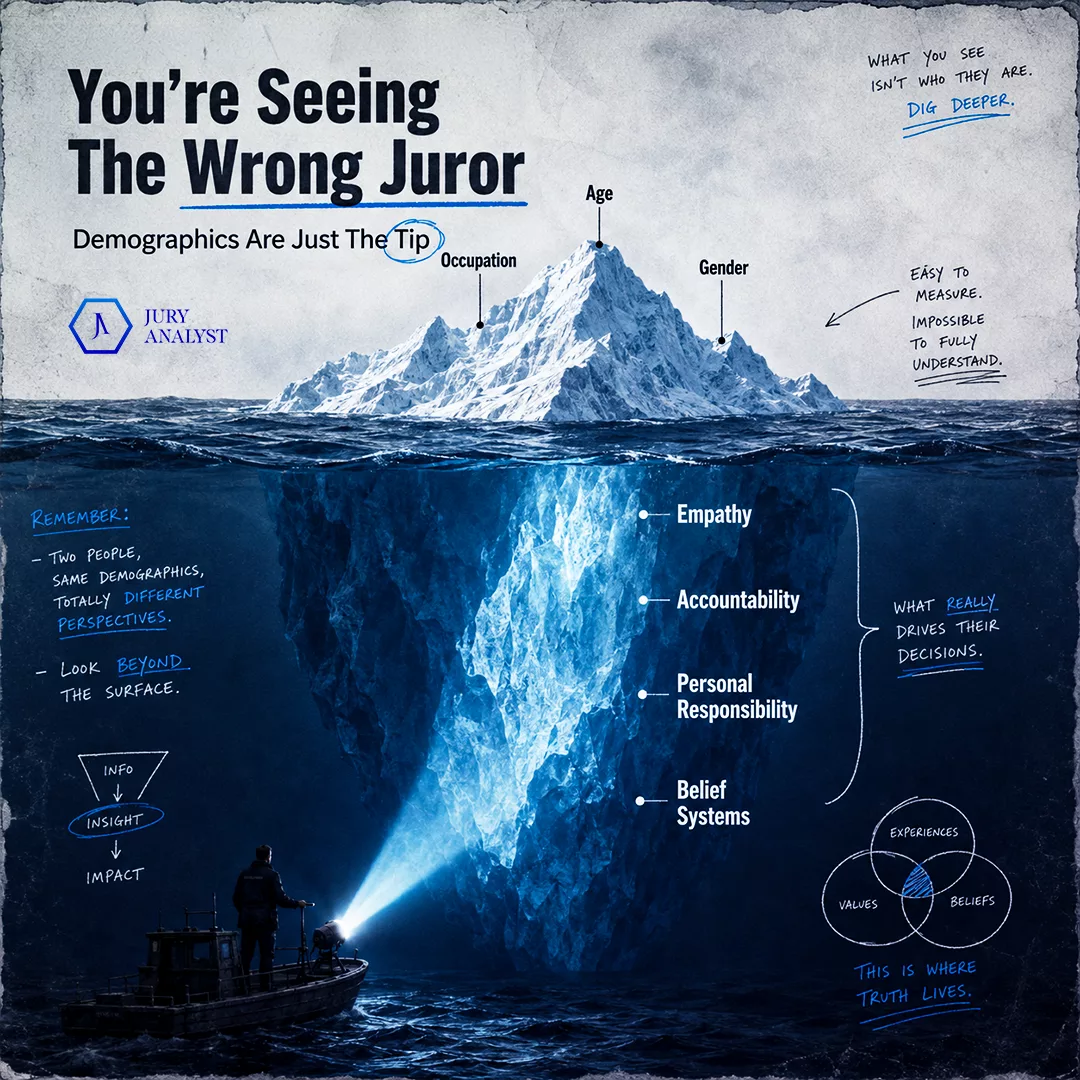
The strongest predictors of verdict lean were not age, gender, income, education, marital status, or political registration.
Instead, attitudes and dispositions mattered more:
- How people think about accountability
- How they define fairness
- Their views about lawsuits
- Their perceptions of personal responsibility
- Their willingness to trust institutions
- Their capacity for empathy
In other words, the invisible factors often matter more than the visible ones.
That finding is consistent with decades of jury science. It also raises an important question.
If demographics are relatively weak predictors, what should trial teams be paying attention to instead?
The Most Important Finding Was Not About Jurors
Perhaps the most important takeaway from behavioral research is not about jurors at all.
It is about the case itself.
Many lawyers assume jury selection is where verdicts are won or lost.
The data suggests a more nuanced reality.
Juror characteristics matter.
But they explain only a relatively small portion of outcome variation.
The dominant variable remains the case.
Not the demographics.
The story.
Not the stereotypes.
The evidence.
Not the assumptions.
The credibility of witnesses. The clarity of responsibility. The emotional reality of the harm.
Jurors do not award accountability because they belong to a particular demographic category.
They award accountability when accountability feels justified.
That distinction matters because it shifts strategic attention away from finding the perfect juror and toward ensuring the case is being understood the way the trial team intends.
The Difference Between the Case Lawyers Know and the Case Jurors Experience
Every trial team operates within two versions of the same case.
The first is the case lawyers know.
The second is the case jurors experience.
The case lawyers know is built from discovery, expert analysis, depositions, timelines, and evidence.
The case jurors experience is built from perception:
- Who seems trustworthy?
- Who appears responsible?
- What feels fair?
- What feels incomplete?
- What does not make sense?
Those are not the same thing.
And the distance between them is where surprises often occur.
A trial team may spend months focused on regulatory failures, internal communications, safety violations, or causation.
Jurors may focus on a completely different issue.
A single decision.
A single action.
A single moment involving the plaintiff.
Not because it changes liability.
Because it changes perception.
Jurors do not simply process facts.
They assign meaning to facts.
That reality should shape how every plaintiff team prepares its case.
Why Strong Cases Still Encounter Resistance
One of the most common mistakes in litigation is assuming a strong case will naturally feel strong to jurors.
Sometimes it does.
Sometimes it does not.
Somewhere inside every catastrophic injury, wrongful death, product liability, or medical malpractice case is a person whose life has been permanently altered.
The trial team understands that reality deeply.
The challenge is helping jurors experience that reality with the same clarity.
That requires more than proving facts.
It requires understanding interpretation.
Because jurors do not evaluate evidence through the same framework lawyers use. They evaluate evidence through the lens of human experience.
Who feels responsible?
Who feels credible?
What feels fair?
Those questions often carry enormous influence inside the deliberation room.
Why Testing Assumptions Matters More Than Predicting Outcomes
This is where many conversations about focus groups, mock juries, and behavioral testing become misunderstood.
The objective is not prediction.
No responsible research process can guarantee how a future jury will decide a case.
The value lies elsewhere.
Calibration.
The strongest trial teams test assumptions before jurors do.
Not because they expect certainty.
Because they want to identify hidden risks.
They want to understand:
- Where narratives fracture
- Which defense themes gain traction
- Which witnesses create friction
- Which damages arguments resonate
- Which assumptions the trial team never realized it was making
Every case contains a counter-story.
The question is whether the trial team discovers it before the defense does.
Or before the jury does.
The New Standard for Plaintiff Trial Strategy
The legal profession is steadily moving toward evidence-based litigation strategy.
Not because experience has become less valuable.
Because experience becomes more valuable when paired with measurement.
The strongest plaintiff advocates still rely on judgment. They still rely on storytelling. They still rely on human connection.
What is changing is their willingness to challenge their own assumptions.
The future of plaintiff advocacy will not belong to the firms with the strongest folklore.
It will belong to the firms most willing to pressure-test their certainty.
Because accountability begins with evidence.
And that principle should apply to trial strategy just as much as it applies to the cases themselves.
The most dangerous thing a trial team can do is mistake internal agreement for external persuasion.
The most effective trial teams make sure that question is answered long before twelve strangers are asked to answer it themselves.
Want more on this topic?
We explore this topic further on the Science of Justice podcast, including:
- Why courtroom folklore survives despite weak evidence
- How confirmation bias shapes jury-selection decisions
- Why demographics often underperform attitudes as predictors
- The difference between the visible case and the perceived case
- How leading plaintiff teams pressure-test assumptions before trial
- Why jury selection is primarily a risk-management tool rather than a verdict strategy