

Why the strongest trial strategy is often designed long before trial begins
Some of the most damaging problems in plaintiff litigation do not begin at trial.
They begin quietly.
In the first version of the case story. In the discovery plan that followed that story. In the deposition question that checked a legal box but missed the human frame. In the damages narrative that was documented, but never truly developed. In the defense explanation that was obvious in hindsight but never pressure-tested early enough.
By the time these problems appear at mediation or trial, they can feel sudden. But most are not sudden. They are structural.
The courtroom often reveals problems that were built into the case months or years earlier.
That is why modern plaintiff trial strategy requires more than preparation. It requires architecture.
The Problem With Building Forward
Most litigation naturally moves forward.
A client comes in. The team gathers intake facts. Medical records follow. Written discovery begins. Depositions are scheduled. Experts are retained. Damages evidence is compiled. A mediation brief is drafted. If the case does not resolve, trial themes are refined.
This sequence is procedurally normal. It mirrors the rhythm of litigation.
But it can create a strategic trap.
When a case is built only in the order information arrives, strategy can become reactive. The file begins to dictate the case instead of the case strategy shaping the file.
The team responds to what appears next. A record lands, a document is produced, a deposition is taken, an expert report is received, and each step gets folded into the existing theory.
Over time, that theory becomes familiar. Familiarity can feel like strength. But internal familiarity is not the same as external persuasion.
The case the trial team knows is not always the case a mediator, insurer, judge, or juror experiences.
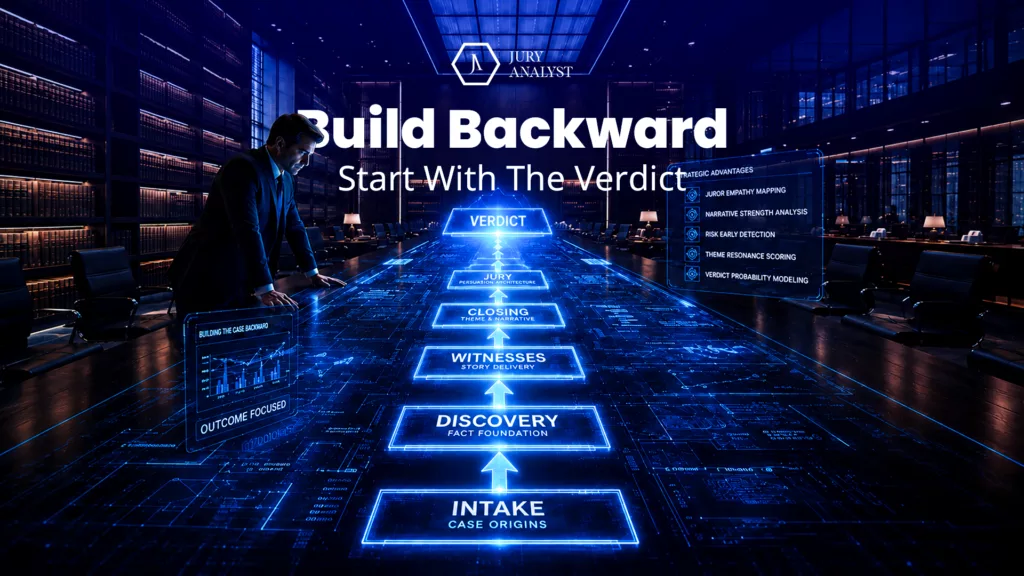
Start With the Decision-Maker
A stronger approach begins with a different question.
Not simply:
“What happened?”
But:
“What will the eventual decision-maker need to understand, believe, remember, and repeat?”
That decision-maker may be a juror. It may be a mediator. It may be opposing counsel, an insurer, or a judge. But the strategic discipline is the same: identify the final understanding the case must support, then work backward.
What must be proven? What must be clarified? What must be made human? What defense argument must be anticipated? What facts will matter to someone outside the case? What testimony needs to be developed before the opportunity disappears?
This is not about forcing a rigid story onto a developing case. Good strategy must adapt as evidence changes.
It is about maintaining a clear destination.
A plaintiff team cannot know every turn the case will take. But it should know what the case ultimately needs to make understandable, credible, and fair.
The Legal Blueprint
One useful discipline is to think early about the case’s legal endpoint.
What will the jury eventually be asked to decide? What elements must be proven? What defenses must be addressed? What legal standards will shape relevance? What evidence will matter, and what evidence may only feel interesting?
This legal blueprint helps prevent a common problem: gathering enormous amounts of information without developing the proof that actually advances the case.
Without an end-stage framework, discovery can become expansive but unfocused. Depositions can become technically thorough but strategically incomplete. Expert work can become credentialed but disconnected from human meaning.
The result is a file that looks developed but still lacks persuasive architecture.
The goal is not to reduce trial strategy to legal checklists. Plaintiff cases are human cases. But the legal structure matters because it defines what the case must ultimately establish.
The strongest strategies often combine both: legal clarity and human meaning.
Legal Proof Is Not Enough
Plaintiff teams need legal proof. That is non-negotiable.
They need admissible evidence. They need records. They need testimony. They need experts. They need to satisfy the legal elements of the claim.
But legal proof alone may not be enough to move a decision-maker.
A deposition admission may satisfy an element, but if the witness sounds calm, reasonable, and credible, the admission may not carry the weight the team expected.
A medical record may document serious harm, but if the human loss is not made concrete, the injury can become a diagnosis rather than a changed life.
A liability theory may be legally sound, but if ordinary people hear blame instead of accountability, the moral center of the case may not land.
Plaintiff teams also need what could be called jury proof: the contextual, human, credibility-based proof that helps ordinary people understand why the case matters and why the requested outcome is fair.
This is where strategy often fails quietly. The team develops evidence that satisfies the law but not the human interpretation of the case.
Discovery Shapes Meaning
Discovery is often described as fact gathering.
But in serious plaintiff litigation, discovery is also meaning development.
Every document request, deposition question, and witness-development decision affects the story that can later be told.
A broad discovery plan may collect a large volume of material. But volume is not clarity. The more important question is whether discovery is developing the proof the eventual decision-maker will need.
That may include:
- The document that shows notice
- The witness who explains the real-world consequence of a safety failure
- The testimony that gives context to a technical violation
- The fact that neutralizes a likely defense theme
- The detail that turns an abstract injury into a lived reality
Discovery should not only ask, “What can we obtain?”
It should ask, “What will we later need to explain this case clearly, and what might be impossible to recover if we wait?”
That shift changes the function of early case development. Discovery becomes less about accumulation and more about strategic construction.
Damages Need Development
Damages are especially vulnerable to late development.
The file may contain medical records, bills, diagnoses, expert reports, and life-care projections. But those materials do not automatically communicate the human meaning of loss.
A catastrophic injury is not only a medical event. It is a disruption of daily life, identity, independence, dignity, family roles, work, physical freedom, and future possibility.
If that meaning is not developed early, the case may reach mediation with a damages number but without a damages story.
That is dangerous.
A mediator may see the number. The defense may see the demand. A future jury may see the records. But unless the human consequences are concrete, the harm can remain emotionally underdeveloped.
The strongest damages narratives are not assembled at the end. They are discovered, clarified, and protected throughout the life of the case.
Mediation Exposes Architecture
Mediation often becomes the first serious test of whether the case has been built clearly enough for someone outside the firm.
That is why it can be so revealing.
The team may believe the liability story is strong. The injuries may be severe. The experts may be credible. The demand may feel justified.
But if the story is not clear to outsiders, mediation exposes the weakness.
Sometimes the damages story is too abstract. Sometimes the defense has the simpler explanation. Sometimes a witness credibility issue was underestimated. Sometimes the case makes sense to lawyers but not to lay decision-makers. Sometimes the team has legal proof but not enough persuasive clarity.
A mediation brief cannot rescue a case that has not been developed. It can only reveal what has already been built.
By then, discovery may be closed. Depositions may be complete. Experts may be locked in. Settlement posture may already be hardened.
The later a plaintiff team finds the friction, the fewer options remain.
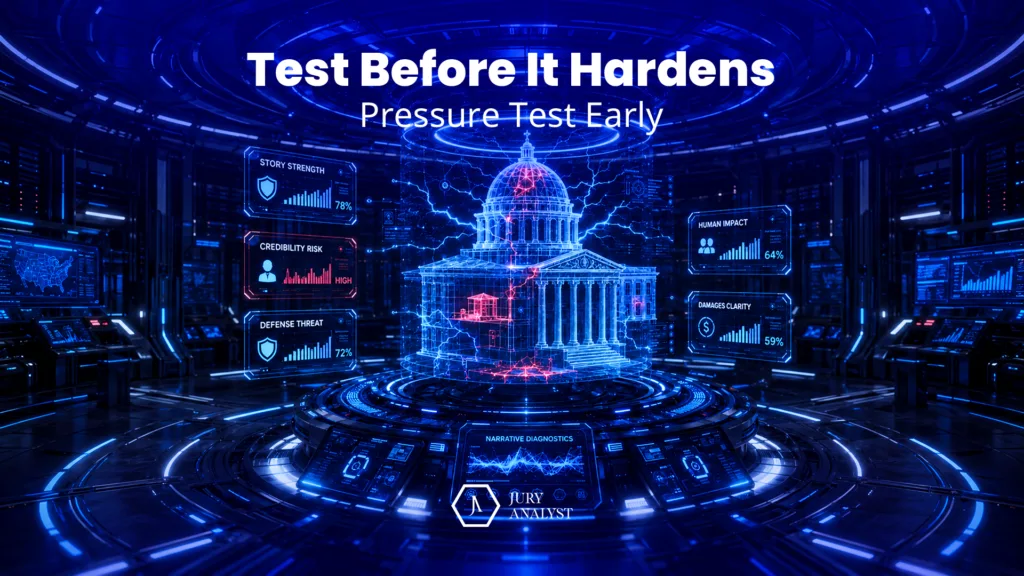
Pressure-Test Before Rigidity
Early pressure-testing is not about predicting a result.
It is about preserving strategic flexibility.
The purpose is to identify where the case is confusing, where the damages story feels abstract, where a witness may be misunderstood, where the defense explanation may gain traction, and where the team’s internal confidence may be masking external resistance.
That kind of feedback is most valuable before the case hardens.
Before discovery closes. Before key depositions are over. Before expert opinions are finalized. Before mediation positions become fixed. Before trial prep becomes a repair exercise.
This is where Jury Analyst and Jury Simulator fit into a broader plaintiff-side strategy framework.
Not as replacements for trial lawyers. Not as substitutes for trial consultants. Not as guarantees of outcome.
Their value is in helping plaintiff teams surface friction earlier: narrative gaps, communication risks, credibility concerns, damages clarity issues, defense-theme vulnerabilities, and juror-perspective variation.
The point is not to remove human judgment from strategy. It is to give human judgment better information before the case becomes too rigid to reshape.
The Strategic Question
The strongest plaintiff teams do not simply ask whether they have evidence.
They ask whether they are building the right case.
That distinction matters.
A file can be complete and still not be clear. A case can be legally strong and still feel emotionally underdeveloped. A deposition can secure an admission and still miss the human frame. A damages demand can be supported and still fail to communicate loss. A theory can feel obvious internally and still be misunderstood externally.
The strategic question is not only, “Can we prove this?”
It is:
“Can the decision-maker understand why this proof matters?”
That question should not wait until trial prep.
It belongs at intake. In discovery planning. Before depositions. During expert development. Before mediation. Throughout the case.
Because some trial problems are not born at trial.
They start much earlier.
And by the time they appear in the courtroom, they may already be difficult to fix.
Want More on This Topic?
We explore this issue further on the Science of Justice podcast, including:
- Why some trial problems begin as early case-development problems
- How chronological case-building can create strategic drift
- Why jury instructions can serve as an early legal blueprint
- The difference between legal proof and jury proof
- How discovery choices shape the story that can later be told
- Why mediation often exposes narrative gaps too late
- How early pressure-testing helps plaintiff teams preserve flexibility
Episode: The Case That Was Built Backwards