
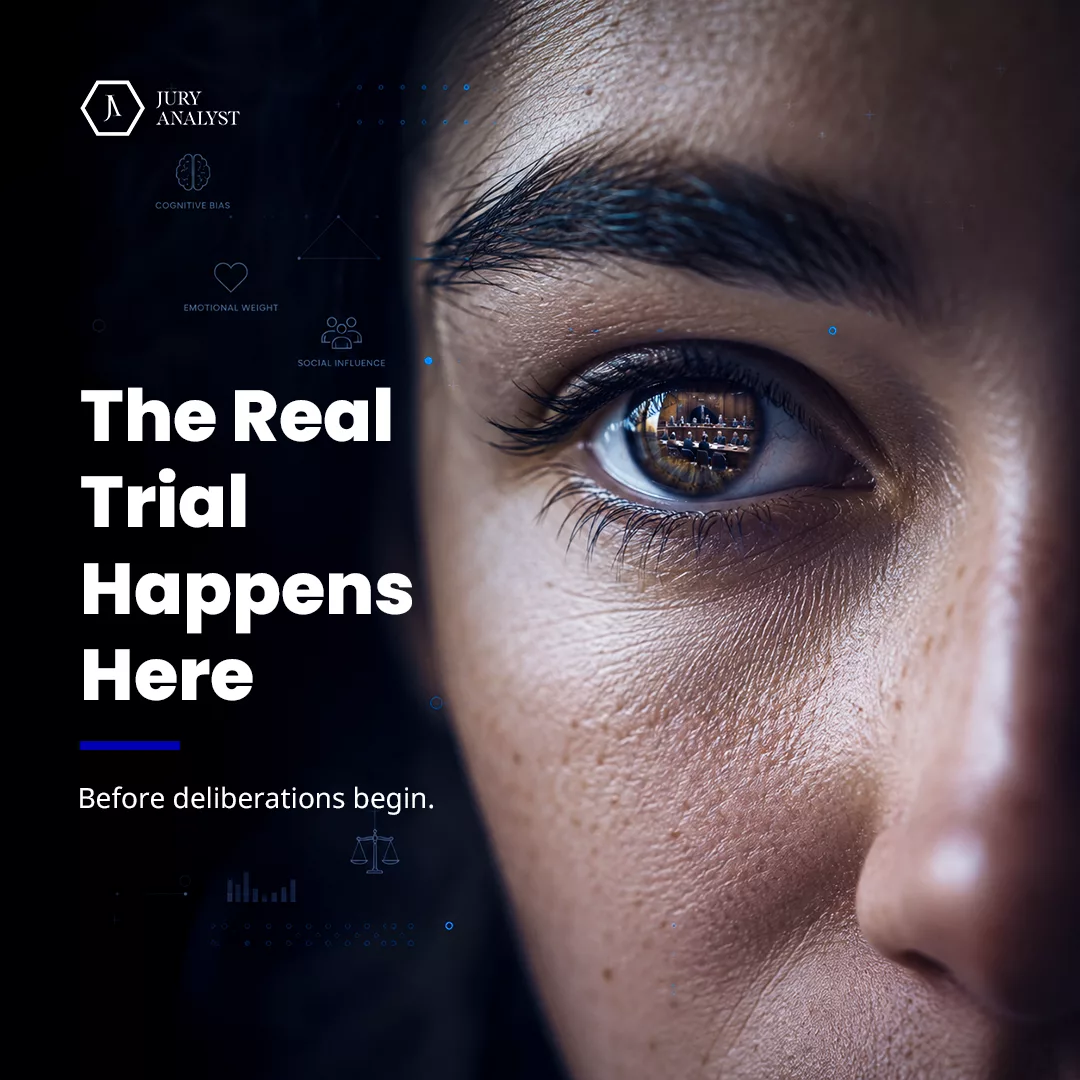
Plaintiff lawyers spend years building evidence. Jurors spend a lifetime building beliefs. The outcome often depends on how those beliefs shape the meaning of the facts.
Most plaintiff trial lawyers can identify the visible risks in a case: a damaging document, a difficult witness, an unfavorable venue, a weak expert, or an unexpected ruling. These risks are tangible. They can be researched, analyzed, and prepared for.
But some of the most consequential risks in civil litigation never appear in a deposition transcript, expert report, or discovery response. They enter the courtroom sitting in the jury box.
Every juror arrives carrying a lifetime of experiences, assumptions, values, and beliefs about responsibility, fairness, corporations, medicine, money, and accountability. Those beliefs influence how evidence is interpreted long before deliberations begin.
This creates a challenge many plaintiff trial teams underestimate. A case can be factually strong. A witness can be credible. A damages model can be well-supported. Yet jurors may still assign a meaning to the evidence that is very different from the one the trial team intended.
Not because jurors are irrational, but because human beings do not process information in a vacuum. They process information through the lens of who they already are.
That may be the hidden variable that shapes more verdicts than any exhibit, witness, or demonstrative ever could.
The Myth of the Blank-Slate Juror
The courtroom is often imagined as a place where facts are weighed objectively. Jurors enter with open minds. Evidence is presented. Arguments are made. A verdict follows.
That ideal is powerful, but human decision-making rarely works that cleanly.
Every juror enters the courtroom with a preexisting framework for understanding the world. That framework is shaped over decades by personal experiences, professional background, family influence, cultural narratives, media exposure, and lived reality.
Jurors are not simply absorbing information. They are interpreting it.
A medical malpractice case is not viewed only through medical records and expert testimony. A product liability case is not evaluated only through engineering reports and safety standards. A catastrophic injury claim is not judged only by medical bills, life care plans, and economic loss calculations.
Every fact passes through a deeper set of questions: Can people generally be trusted? Should individuals be responsible for protecting themselves? Do corporations prioritize profits over safety? Are lawsuits necessary for accountability? Do people exaggerate injuries? Are large damage awards justified?
Jurors may never say these questions out loud. But they often answer them internally throughout trial.
And those answers shape the meaning of the case.
Facts Do Not Speak for Themselves
One of the most persistent myths in litigation is that facts speak for themselves. They do not. Facts are interpreted through narratives.
When human beings are given complex or incomplete information, they naturally organize it into a story. That story helps them make sense of uncertainty.
Trials are filled with uncertainty. Jurors did not witness the event. They receive evidence in pieces. Witnesses testify out of sequence. Documents appear in fragments. Experts translate technical issues into language jurors may be hearing for the first time.
So jurors do what people always do when faced with complexity. They build a story.
The strategic question is not whether jurors will construct a narrative. They will. The question is what materials they will use to build it.
Some of those materials come from the evidence. But many come from the juror’s own life.
A juror who had a positive experience with a physician may interpret a medical defendant differently than a juror who once felt ignored by a hospital system. A juror who believes people should be responsible for their own safety may evaluate a serious injury differently than a juror who focuses on corporate prevention and public accountability.
The evidence may be the same. The interpretation is not.
The strongest evidence in the world can lose force when it collides with a belief system strong enough to reinterpret it.
The Difference Between Demographics and Worldview
Trial strategy has long been tempted by demographic shortcuts: age, gender, occupation, income, education, and ZIP code. These variables are easy to see, easy to categorize, and easy to discuss in a conference room.
They are also often too thin to explain how a juror will evaluate a case.
Two jurors can look nearly identical on paper. They may be the same age, work in the same profession, earn similar incomes, and live in the same community. Yet one may believe institutions generally act in good faith, while the other views powerful organizations with deep skepticism.
One may place tremendous weight on personal responsibility. The other may focus on systemic accountability.
Demographically, they appear similar. Psychologically, they are not.
This is why psychographics matter. A juror’s attitudes, values, and worldview often reveal more than surface-level categories ever could.
In plaintiff-side civil litigation, that distinction is not academic. It can shape how jurors interpret liability, causation, damages, credibility, and the moral purpose of the case.
The Trial Jurors Actually Experience
Plaintiff trial teams often prepare the case they know. Jurors decide the case they experience.
Those are not always the same thing.
The trial team has lived with the case for months or years. They know the discovery record, the internal contradictions, the documents that matter, and the deposition answer that changed everything.
To the lawyers, the case may feel clear. To jurors, it is new.
Jurors are building the story in real time. They are deciding what matters, what does not, who feels trustworthy, who seems responsible, and what kind of harm deserves legal recognition.
This gap between the case the lawyers know and the case jurors experience is one of the most important strategic risks in trial preparation.
A trial team may believe a regulatory violation is the heart of the case. Jurors may focus instead on whether the plaintiff “should have known better.” A lawyer may see a corporate email as proof of disregard. Jurors may interpret it as ordinary business language.
A plaintiff may appear composed because they are trying to maintain dignity. Some jurors may read that composure as strength. Others may read it as a lack of serious harm.
This is interpretation risk: the risk that the jury will assign a different meaning to the case than the one the trial team intended.
The Silent Skeptic in the Jury Box
The most dangerous skepticism is not always spoken.
Many jurors carry strong beliefs about lawsuits, injuries, institutions, and money. But they may not identify those beliefs as bias. They may sincerely believe they are fair. They may fully intend to follow the law. They may answer voir dire questions honestly.
Yet their worldview may still shape how they hear the evidence.
A juror who believes people exaggerate injuries may view pain testimony through suspicion. A juror who strongly trusts doctors may resist seeing a medical outcome as negligence. A juror who believes corporations are often unfairly blamed may scrutinize the plaintiff’s choices more aggressively than the defendant’s conduct.
A juror who believes large verdicts harm society may begin resisting damages before the numbers are even explained.
These beliefs often operate quietly. They are not always expressed as hostility. They may appear as caution, reasonableness, skepticism, or a desire to “see both sides.”
For plaintiff trial teams, the challenge is not simply identifying bias. It is identifying the beliefs that will shape interpretation before those beliefs harden into conclusions.
Why Damages Resistance Often Begins Early
Damages present one of the clearest examples of interpretation risk.
Many plaintiff lawyers have experienced it. The liability evidence feels strong. The injuries are severe. Future care needs are substantial. Yet resistance emerges the moment compensation enters the discussion.
The reason often has less to do with mathematics than psychology.
Many jurors arrive carrying cultural narratives about lawsuits and money. Some have been exposed for years to messaging suggesting plaintiffs exaggerate injuries. Others have internalized the belief that large verdicts are inherently excessive.
These assumptions frequently activate before jurors ever review a life care plan or understand future medical needs.
As a result, damages advocacy becomes more than a presentation of numbers. It becomes a reframing exercise.
The most effective plaintiff advocates help jurors understand that damages are not about creating a windfall. They are about addressing permanent loss.
The discussion shifts away from the size of the number and toward the reality of the harm. What will it take to provide care? What will it take to preserve dignity? What will it take to replace opportunities that were permanently taken away?
When jurors understand damages through that lens, they are often evaluating a fundamentally different question.
The Credibility Challenge Most Trial Teams Miss
Another hidden risk emerges when trial teams assume legal credibility and emotional credibility are the same thing.
They are not.
A witness can be truthful and still be misunderstood. A plaintiff can be authentic and still trigger skepticism. A client who remains composed while discussing catastrophic injuries may be viewed as strong and resilient by one juror. Another juror may interpret the same behavior as evidence that the injuries are not severe.
A highly emotional witness may appear genuine to some jurors and performative to others.
Neither interpretation is necessarily rooted in the witness alone. Both are shaped by the worldview of the observer.
This creates a challenge for plaintiff teams. The goal cannot be manufacturing a perfect emotional presentation. Human beings are too complex for that.
Instead, the objective is authenticity.
Jurors may disagree about what authenticity looks like, but they are remarkably effective at identifying what feels artificial. The more a presentation appears overly rehearsed or strategically engineered, the more likely skeptical jurors are to question it.
Authenticity does not eliminate bias. But it often provides the strongest defense against it.
The Danger of Internal Certainty
Perhaps the most dangerous phrase in trial strategy is: “It’s obvious.”
When lawyers say something is obvious, they are often describing familiarity rather than persuasion.
Trial teams live with cases for months or years. They review every document, analyze every deposition, study every timeline, and debate every strategic decision.
Over time, the liability narrative becomes deeply familiar. The causation argument becomes intuitive. The damages model feels self-evident.
Jurors have none of that context.
They encounter the case for the first time. What feels obvious to the trial team may not feel obvious to them at all.
This creates one of the largest blind spots in litigation. The stronger a team’s internal certainty becomes, the easier it is to overlook how differently jurors may experience the case.
That is why successful plaintiff advocacy requires more than confidence. It requires curiosity.
Curiosity about competing interpretations. Curiosity about resistance points. Curiosity about the narratives jurors may construct independently.
The goal is not simply presenting the case. The goal is understanding how the case will be experienced.
Preparing for Interpretation Risk
Modern trial strategy increasingly recognizes that persuasion is not solely about evidence. It is about interpretation.
The strongest plaintiff teams do not assume jurors will see the case exactly as they do. They actively search for alternative narratives, identify worldview friction, pressure-test assumptions, and explore how different audiences might respond to the same evidence.
This process is not about predicting verdicts. Human decision-making is too complex for certainty.
Instead, it is about uncovering strategic blind spots before trial begins. It is about identifying the invisible barriers standing between a strong case and a persuasive one.
Most importantly, it is about acknowledging a reality many litigators learn only after trial: the biggest threat to a plaintiff’s case is not always opposing counsel.
Sometimes it is the interpretation the jury creates on its own.
The Strategic Imperative for Plaintiff Lawyers
Evidence remains essential. Facts matter. Experts matter. Witnesses matter. None of these fundamentals are changing.
But modern plaintiff advocacy requires something more.
It requires understanding that evidence does not arrive in an empty room. Every fact enters a courtroom already competing with beliefs that were formed years or decades before trial.
The trial team’s responsibility is not simply proving what happened. It is helping jurors understand what those facts mean.
The lawyers who recognize this hidden variable gain a strategic advantage. They prepare not only for the evidence they intend to present, but for the beliefs already waiting to receive it.
And in many cases, that distinction may determine whether a verdict reflects the facts of the case or the assumptions jurors brought with them into the courtroom.
Want More on This Topic?
We explore this topic further on the Science of Justice Podcast, including:
- Why jurors are not blank slates when they enter the courtroom
- How beliefs shape the interpretation of evidence
- The difference between demographics and psychographics
- Why damages resistance often begins before damages are discussed
- The hidden influence of personal responsibility narratives
- How credibility is filtered through juror worldviews
- Why trial teams must prepare for interpretation risk, not just presentation
- How modern behavioral analysis can expose strategic blind spots before trial
Episode: The Juror Who Decided Before You Spoke
How Jury Analyst Helps
At Jury Analyst, we help plaintiff trial teams understand not only the evidence in a case, but how that evidence may be interpreted by the people ultimately asked to decide it.
Through research methodologies and Jury Simulator, we help teams explore how different juror perspectives may evaluate liability, causation, damages, witness credibility, and case themes before stepping into the courtroom.
Because the question is not simply whether your case is strong.
It is whether the jury will experience it the way you intend.