
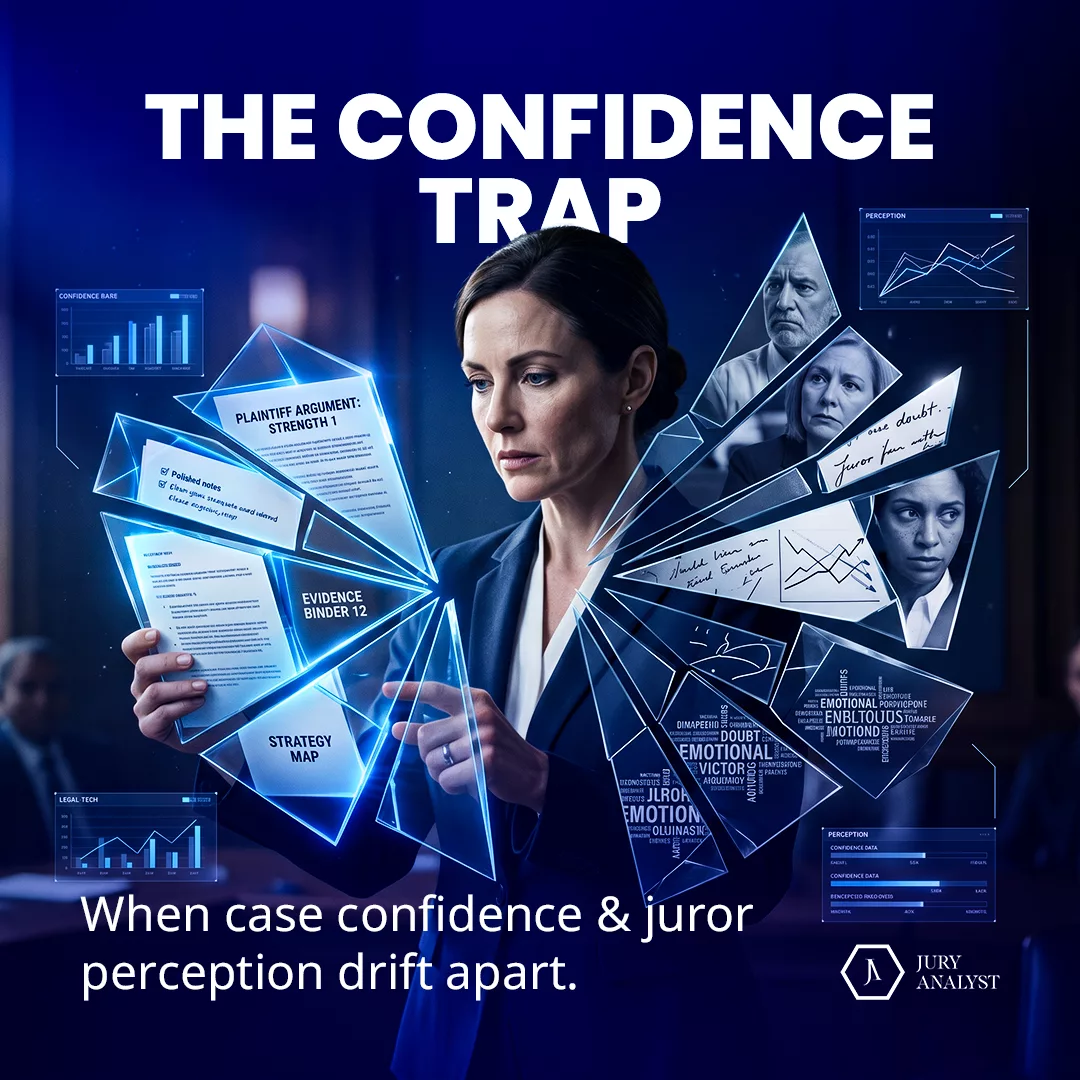
Modern plaintiff litigation requires structured feedback to close the gap between case confidence and juror interpretation.
A plaintiff case can feel exceptionally strong inside the litigation team and still land very differently with jurors.
That is one of the most difficult realities in modern plaintiff trial strategy.
The documents are organized. The experts support the theory. The timeline is clear. The harm is serious. The internal team understands why the case matters.
But jurors are not entering the case through the same door.
They do not begin with pleadings, discovery, expert reports, or legal elements. They begin with perception. They begin with trust. They begin with questions about responsibility, credibility, fairness, and whether the story fits what they already believe about how the world works.
For experienced plaintiff trial lawyers, this creates a difficult but important reality: experience remains essential, but even experience benefits from structured pressure-testing in modern civil litigation.
The issue is not whether seasoned trial lawyers have value. They do. Pattern recognition, courtroom judgment, witness instincts, and strategic discipline are built over years of practice. There is no substitute for that.
The issue is whether internal confidence is being tested against how jurors may actually interpret the case.
In today’s plaintiff litigation environment, untested confidence can become a strategic liability.
Legal Strength Is Not the Same as Juror Strength
Trial lawyers are trained to evaluate cases through legal structure.
They ask:
- Is there a duty?
- Was it breached?
- Can causation be proven?
- Is the evidence admissible?
- Can the expert support the theory?
- How will the record hold up under scrutiny?
These are necessary questions.
But they are not the only questions that matter.
Jurors are asking something different:
- Who do I trust?
- Who feels responsible?
- Does this story make sense?
- Why did this happen?
- Could the plaintiff have avoided it?
- Is the harm connected to the conduct?
- Does the requested accountability feel fair?
This is the distinction between legal proof and jury proof.
Legal proof satisfies the requirements of the case. Jury proof helps human decision-makers understand why those facts matter.
A case can be legally sufficient and still psychologically fragile. That gap often goes unnoticed because trial teams spend so much time inside the legal architecture of the case that the juror’s perspective becomes secondary.
But jurors do not experience a case as a legal architecture.
They experience it as a human story.
Jurors Build Stories Before They Analyze Arguments
Jurors do not passively absorb evidence.
They organize it.
They fill gaps.
They make assumptions.
They compare conduct to their own expectations.
They interpret facts through personal experience, community values, institutional trust, economic anxiety, and subconscious bias.
In a premises case, jurors may not begin by asking whether the property owner failed to follow reasonable safety practices. They may begin by wondering why the plaintiff did not see the hazard.
In a medical negligence case, jurors may not begin with the standard of care. They may begin with their own experiences of doctors, hospitals, fear, trust, or confusion.
In a trucking case, jurors may not immediately see a systems failure. They may see a road event and search for a simpler explanation.
In a product liability case, jurors may not begin with design decisions or warning adequacy. They may begin with assumptions about personal choice, product use, or personal responsibility.
This is why strong evidence is not always enough.
The facts matter, but the frame determines how the facts are processed.
The War Room Is Not the Jury Room
The internal litigation environment creates its own form of confidence.
Over months or years, a plaintiff trial team becomes fluent in the case. The team knows the timeline. The team understands the medicine. The team sees the importance of a document that may appear mundane to an outsider. The team knows why a deposition answer matters.
That fluency is useful, but it can also distort perspective.
Inside the war room, language hardens. Assumptions become familiar. The case theory becomes repeated. Internal agreement begins to feel like external validation.
But familiarity is not proof of clarity.
What feels obvious to the trial team may feel confusing to jurors. What feels emotionally powerful to the team may feel incomplete to jurors. What feels like a minor gap internally may become the very issue jurors use to organize the entire case.
The more deeply a team understands the case, the easier it becomes to forget what it is like to encounter the facts for the first time.
That is where confidence becomes fragile.
Plaintiff Lawyers Are Not Immune to Bias
Cognitive bias is often discussed in relation to jurors.
But trial teams are human decision-makers too.
Confirmation bias can lead teams to overweight evidence that supports the existing theory and underweight evidence that complicates it.
Belief perseverance can cause a team to remain attached to a narrative even after outside feedback suggests jurors are interpreting the facts differently.
Naive realism can create the assumption that because the litigation team sees the case clearly, jurors will see it the same way.
Sunk cost pressure can make it harder to revisit assumptions after significant time, money, and effort have already been invested.
None of this is a character flaw.
It is how human cognition works.
The risk is not that experienced plaintiff lawyers have instincts.
The risk is that those instincts are not always pressure-tested early enough, often enough, or through sufficiently structured feedback.
The danger is not confidence.
The danger is unmeasured confidence.
Experienced judgment becomes more reliable when it is continuously tested against how jurors may actually organize and interpret the case.

Why Experience Alone Stops Scaling
Experience is a powerful pattern-recognition system. It helps trial lawyers recognize familiar risks, anticipate witness problems, assess credibility, and understand courtroom dynamics.
But modern plaintiff litigation is asking that system to process more variables than ever before.
Today’s cases often involve:
- large discovery records,
- digital evidence,
- specialized expert testimony,
- complex medical causation,
- corporate systems,
- institutional decision-making,
- and shifting juror attitudes.
At the same time, jurors are bringing different assumptions into the courtroom.
Many jurors are skeptical of institutions, conditioned to distrust lawsuits, and carry strong views about personal responsibility.
Many are influenced by fragmented media environments and local attitudes that may not match national assumptions.
A single lawyer’s experience, even when substantial, cannot account for all of those variables in every case.
This does not reduce the importance of experience.
It changes how experience should be used.
Experience should not stand alone as the final measure of case strength. It should be paired with structured feedback that can reveal where internal assumptions do not match juror interpretation.
The Problem With Testing Too Late
One of the most common risks in plaintiff trial preparation is waiting too long to test the case.
By the time a case reaches:
- late-stage mock trial,
- mediation,
- or final trial preparation,
many strategic decisions are already locked in.
Discovery has closed.
Experts have been selected.
Witness themes have developed.
Depositions have been taken.
The case story has been repeated internally so often that it feels settled.
At that point, outside feedback may still be useful, but its ability to shape the case is more limited.
Early feedback can do something different.
It can reveal which facts jurors find important before discovery closes.
It can identify where jurors are assigning responsibility.
It can show whether the plaintiff’s conduct is becoming the center of the case when the trial team expected jurors to focus elsewhere.
It can expose confusion before confusion becomes embedded in the presentation.
The best time to identify a strategic blind spot is before the case has been built around it.
From Top-Down Preparation to Bottom-Up Understanding
Traditional case preparation often begins from the top down.
The lawyer starts with the legal elements, maps the evidence onto those elements, builds the expert structure, and organizes the case around what must be proven.
That approach is necessary, but incomplete.
Jurors often approach cases from the bottom up.
They begin with what feels:
- true,
- fair,
- normal,
- suspicious,
- careless,
- safe,
- unsafe,
- believable,
- or emotionally coherent.
Then they organize the evidence around those early impressions.
This creates a major strategic implication for plaintiff teams.
A case cannot only be prepared around what lawyers need to prove.
It must also be prepared around what jurors need to understand.
That requires asking different questions:
- What assumptions will jurors bring into this case?
- What facts will they overweight?
- What facts will they underweight?
- Where will they blame the plaintiff?
- Where will they lose the thread?
- What part of the story feels emotionally credible?
- What part feels too technical, too abstract, or too far removed from everyday experience?
These questions do not replace legal analysis.
They strengthen it by aligning the case presentation with how people actually make decisions.
Structured Feedback as Judgment Calibration
The purpose of structured feedback is not to predict a verdict.
It is not to replace the lawyer’s judgment.
It is not to reduce trial strategy to a formula.
Its value is calibration.
Structured feedback helps plaintiff trial teams compare their internal understanding of the case against how research-based or simulated juror profiles may interpret the same facts, themes, witnesses, and story structure.
That comparison matters because many strategic risks are invisible from inside the team.
A witness may seem credible to lawyers but evasive to jurors.
A timeline may seem clear internally but confusing to outsiders.
A theme may sound compelling in conference but trigger skepticism when heard by lay decision-makers.
A detail the team considers minor may become the psychological hinge of the case.
The goal is not certainty.
The goal is disciplined awareness.
Better information allows better questions.
Better questions allow better refinement.
Better refinement gives experienced plaintiff lawyers a stronger foundation for judgment.
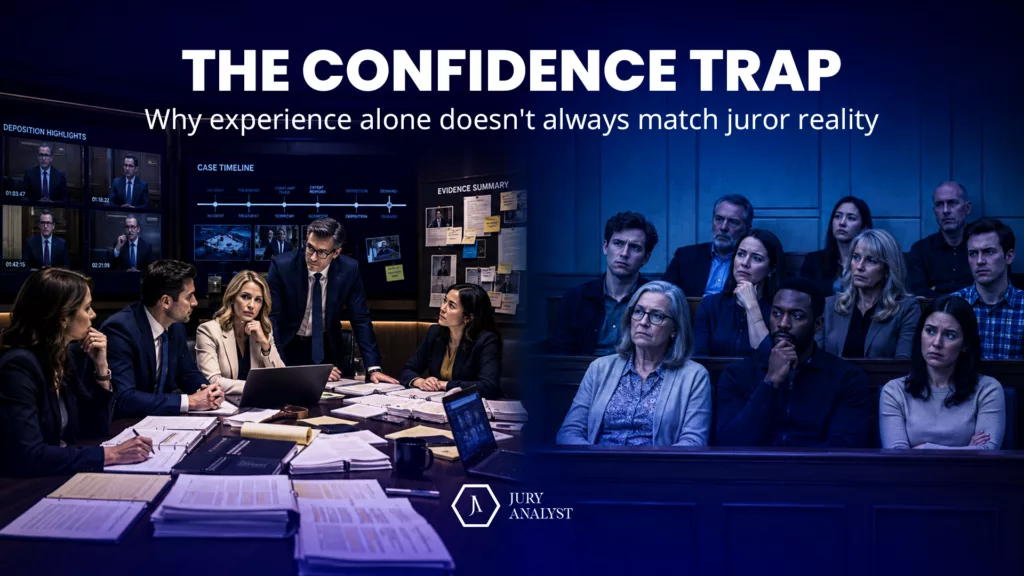
Confidence With Calibration
The future of plaintiff trial strategy is not experience versus data.
That is the wrong frame.
The future belongs to teams that can integrate:
- experience,
- behavioral science,
- venue-specific insight,
- structured feedback,
- and human interpretation
into a continuous preparation process.
Courtroom skill still matters.
Storytelling still matters.
Witness judgment still matters.
Moral clarity still matters.
But modern plaintiff litigation requires more than conviction.
It requires a disciplined process for testing whether that conviction is landing outside the war room.
The strongest plaintiff trial teams are not abandoning experience. They are pressure-testing it earlier, more often, and with greater discipline.
They are building systems around it.
They are asking whether their case is not only legally strong, but psychologically coherent.
They are testing whether jurors may understand the story as intended.
They are identifying where anti-plaintiff assumptions may enter.
They are refining early enough to make meaningful adjustments.
That is the shift from confidence alone to confidence with calibration.
And in modern plaintiff trial strategy, that shift is already underway.
If this shift raises new questions about how cases should be evaluated, we explore those ideas further in the Science of Justice podcast.