
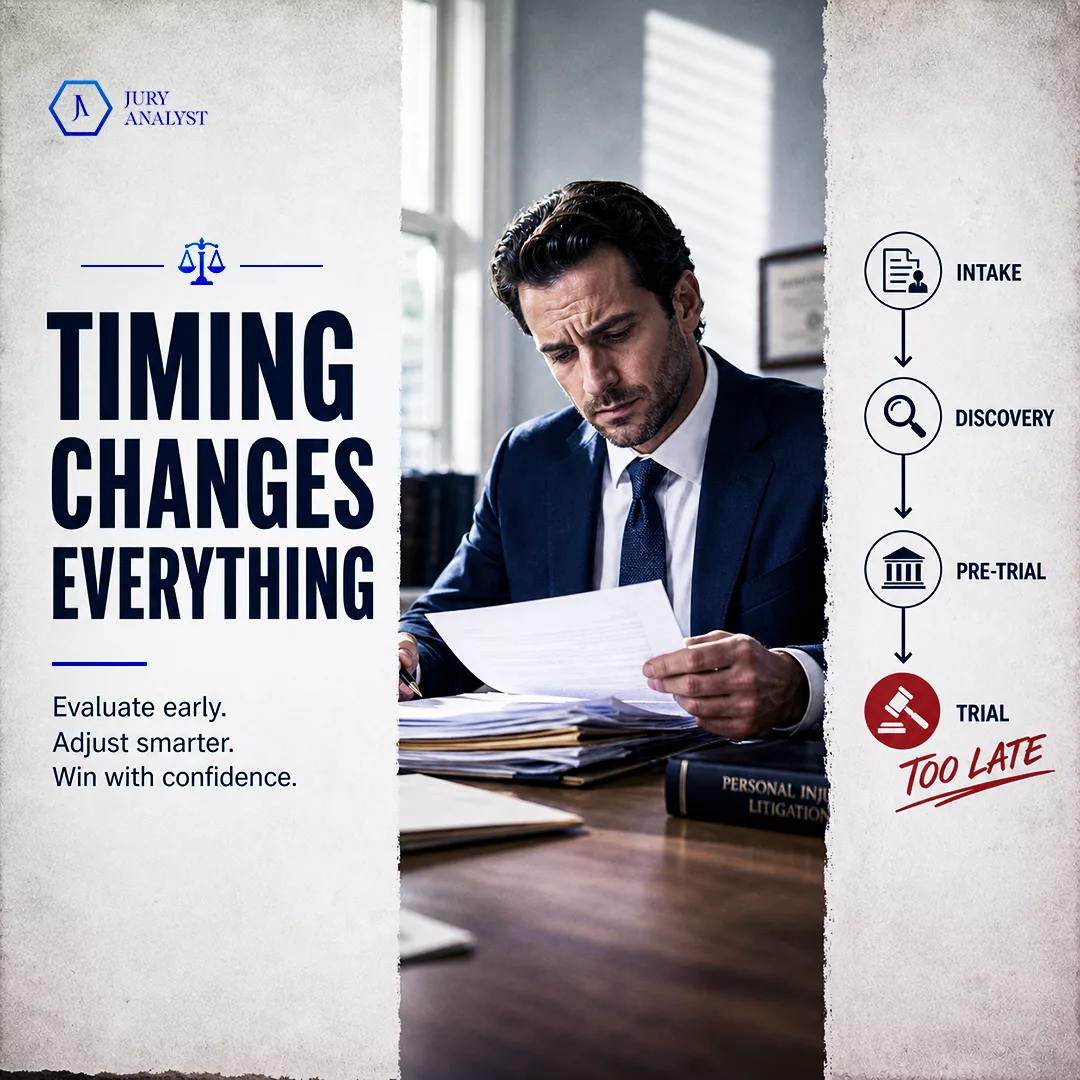
How Continuous Case Evaluation Is Changing Trial Strategy
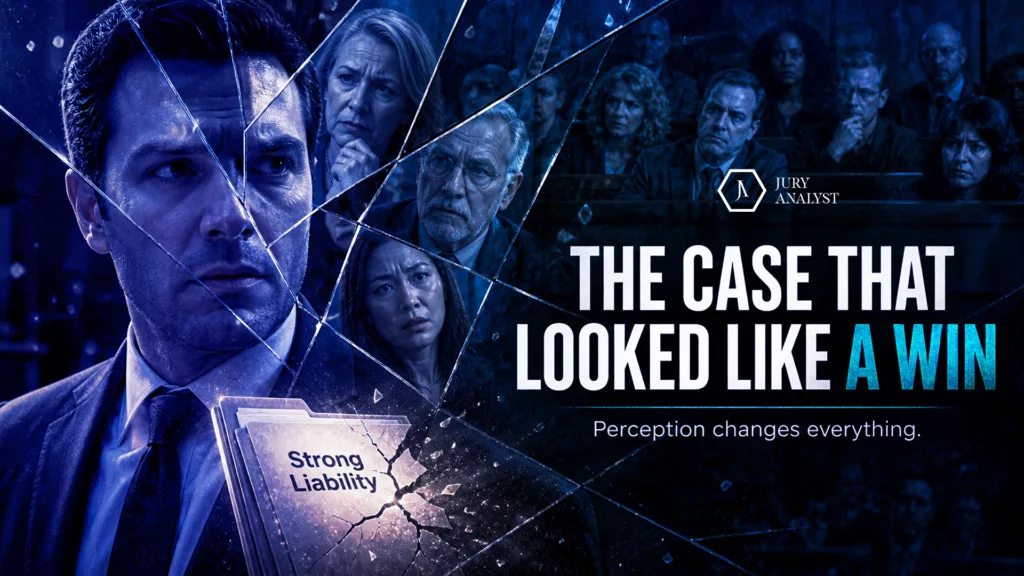
A case can look like a clear win on paper.
- Strong liability.
- Severe harm.
- Nothing, on its face, to explain a loss.
And still fall apart when it is evaluated.
Not because the law failed.
Not because the facts were not there.
Because the case was built one way and evaluated another.
For plaintiff trial teams handling complex civil cases, that gap is becoming harder to ignore.
The limits of a familiar model
For decades, jury consulting has followed a consistent structure.
Trial teams prepare a case.
They may conduct focus groups, mock trials, or support jury selection and trial strategy.
A consultant evaluates how the case is landing and offers strategic guidance.
That model still delivers value.
But it is typically applied at discrete points in the process, often later in case development.
And modern litigation no longer unfolds that way.
Cases evolve continuously. Discovery shifts direction. Depositions reshape credibility. Expert testimony reframes how jurors understand causation.
Each of those developments changes how a case will be interpreted.
Yet many teams are still relying on a model that evaluates juror perception once, often near the end of the process.
That mismatch is where problems begin.
The gap is not effort. It is timing.
When a case underperforms, the instinct is often to revisit preparation.
Did we miss something?
Was the theme not clear enough?
Did the witness fail to connect?
Those questions matter. But they often miss the underlying issue.
The problem is not that the case was poorly built.
It is that it was evaluated too late.
By the time meaningful feedback is introduced, the core narrative has already been shaped. Key decisions have been made. Strategic paths have narrowed.
At that stage, insight becomes reactive rather than formative.
Early decisions carry disproportionate weight
Some of the most consequential decisions in litigation happen before trial preparation formally begins.
How the case is framed at intake.
The language used in written discovery.
The sequencing and tone of depositions.
These decisions define how the case will later be understood.
They determine which facts feel central and which feel peripheral. They influence how credibility is assigned. They shape how responsibility is interpreted.
And yet, they are typically made without direct feedback on how those choices will be received.
This is the structural blind spot in the traditional model.
Why strong cases still lose alignment
There is a deeper dynamic at work that is often underestimated.
Trial lawyers are trained to think in legal structure. Duty. Breach. Causation.
Jurors do not evaluate cases through that framework.
They interpret what they hear through personal experience, belief systems, and a need to maintain a sense of fairness and predictability.
When the facts of a case challenge those beliefs, people do not always adjust their beliefs to fit the facts.
They adjust the narrative.
In some situations, they will construct explanations that were never presented, simply to make the outcome feel consistent with how they understand the world.
This is not a failure of logic. It is a function of how human decision-making works.
And it explains why cases that appear straightforward on paper can shift unexpectedly in evaluation.
The patterns are predictable
Across complex plaintiff cases, several tendencies appear with regularity.
People instinctively look for ways the plaintiff could have avoided harm.
They default to individual actions over systemic conditions.
They simplify complex information when it becomes difficult to process.
They question motives when details feel incomplete.
They consider how an outcome might affect their own lives or communities.
These are not anomalies.
They are consistent features of human judgment under uncertainty.
And importantly, they do not emerge only at trial.
They are present from the moment a case is first evaluated.
From general feedback to decision signals
Traditional consulting often produces valuable observations.
A witness did not connect.
A timeline felt confusing.
A theme lacked clarity.
These insights are useful.
But they are often broad.
Modern litigation requires something more specific.
Trial teams need to understand where the narrative breaks, why it breaks, and what to do about it.
That requires moving from general feedback to decision signals.
Decision signals identify where perception actually breaks:
Where attention drops
What triggers skepticism
Which elements create confusion
When alignment begins to weaken
This level of precision changes how strategy is developed.
The emergence of the analyst team
This is where the model is evolving.
Not away from jury consultants.
But around them. Expanding their role across the case.
What is emerging is a broader structure that extends insight across the full lifecycle of a case.
An analyst team.
This model integrates:
Jury consulting expertise
Behavioral analysis
Structured feedback systems
Case strategy evaluation
The objective is not to replace human judgment.
It is to apply it earlier, more consistently, and with greater visibility.
What continuous evaluation looks like in practice
Continuous evaluation does not require repeated full-scale mock trials.
It requires applying the right level of analysis at the right time.
Early in the case, teams can test how the core narrative is received.
During discovery, they can evaluate how new information shifts perception.
Before trial, they can refine how the full case holds together.
Each stage builds on the previous one.
Each reduces uncertainty.
Each provides an opportunity to adjust while there is still time to do so.

A practical illustration
Consider a case involving severe injury and apparent liability.
On paper, the outcome feels inevitable.
But when the case is evaluated, the response shifts.
Instead of focusing on the defendant’s conduct, evaluators begin asking whether the plaintiff could have acted differently. Some introduce explanations that were never part of the record.
Nothing about the legal framework has changed.
What has changed is how the narrative is being processed.
That shift is not legal.
It is interpretive.
And if it is not identified early, it becomes difficult to correct later.
The role of machine intelligence
Part of what enables this shift is improved infrastructure.
Modern tools allow trial teams to gather feedback earlier and more frequently. They make it possible to compare responses across different scenarios and track how perception evolves over time.
They can surface patterns that would be difficult to detect through observation alone.
This does not replace expertise.
It extends it.
It provides a more consistent view of how a case is being interpreted as it develops.
Expertise remains central
There is a concern that structured analysis diminishes the role of experience.
In practice, the opposite is true.
Experienced consultants and analysts remain essential. They interpret results, guide strategy, and understand nuance.
What changes is the ability to apply that expertise across the entire case lifecycle, rather than at a single point in time.
Why this shift is inevitable
Litigation has changed in fundamental ways.
Cases involve more information.
Timelines are compressed.
The financial exposure is higher.
The traditional model did not fail.
It reached its limit.
A single point of evaluation can no longer keep pace with how cases are built and developed.
Extending analysis across the lifecycle of a case is a practical response to that reality.
What this means for trial teams
The question is no longer whether to involve a jury consultant.
It is how that involvement is structured.
Is insight something that occurs once?
Or is it integrated into the case as it develops?
Teams that adopt the latter approach tend to identify risks earlier.
And early visibility creates options that do not exist later.
It allows for adjustment. Refinement. Reframing.
That flexibility is what improves outcomes.
The takeaway
This is not the end of jury consulting.
It is an expansion of how it is applied.
From isolated checkpoints
To a continuous process
From general feedback
To structured decision signals
From late-stage validation
To early and ongoing case strategy
That shift is already underway.
The question is whether your process has caught up.
If this shift raises new questions about how cases should be evaluated, we explore those ideas further in the Science of Justice podcast.