
Why legally strong closings can fail with jurors and how plaintiff trial teams can pressure test what jurors actually hear.
A plaintiff trial lawyer can deliver a closing argument that is legally precise, beautifully sequenced, rhetorically polished, and professionally impressive.
And still lose the jury.
Not because the law was wrong, the evidence was weak, or the lawyer lacked passion.
But because the people in the jury box did not experience the closing the way the trial team intended.
That disconnect is where many strong closings become vulnerable.
Inside the war room, a closing argument is often evaluated like architecture. Does it include the legal elements? Does it track the evidence? Does it answer the defense? Does it support the verdict form? Does it preserve the record?
Those questions matter. But jurors are not grading the blueprint; they are walking through the house, asking something far more human:
Do I trust this lawyer?
Does this story make sense?
Am I being guided or overwhelmed?
Does the requested verdict feel fair, necessary, and justified?
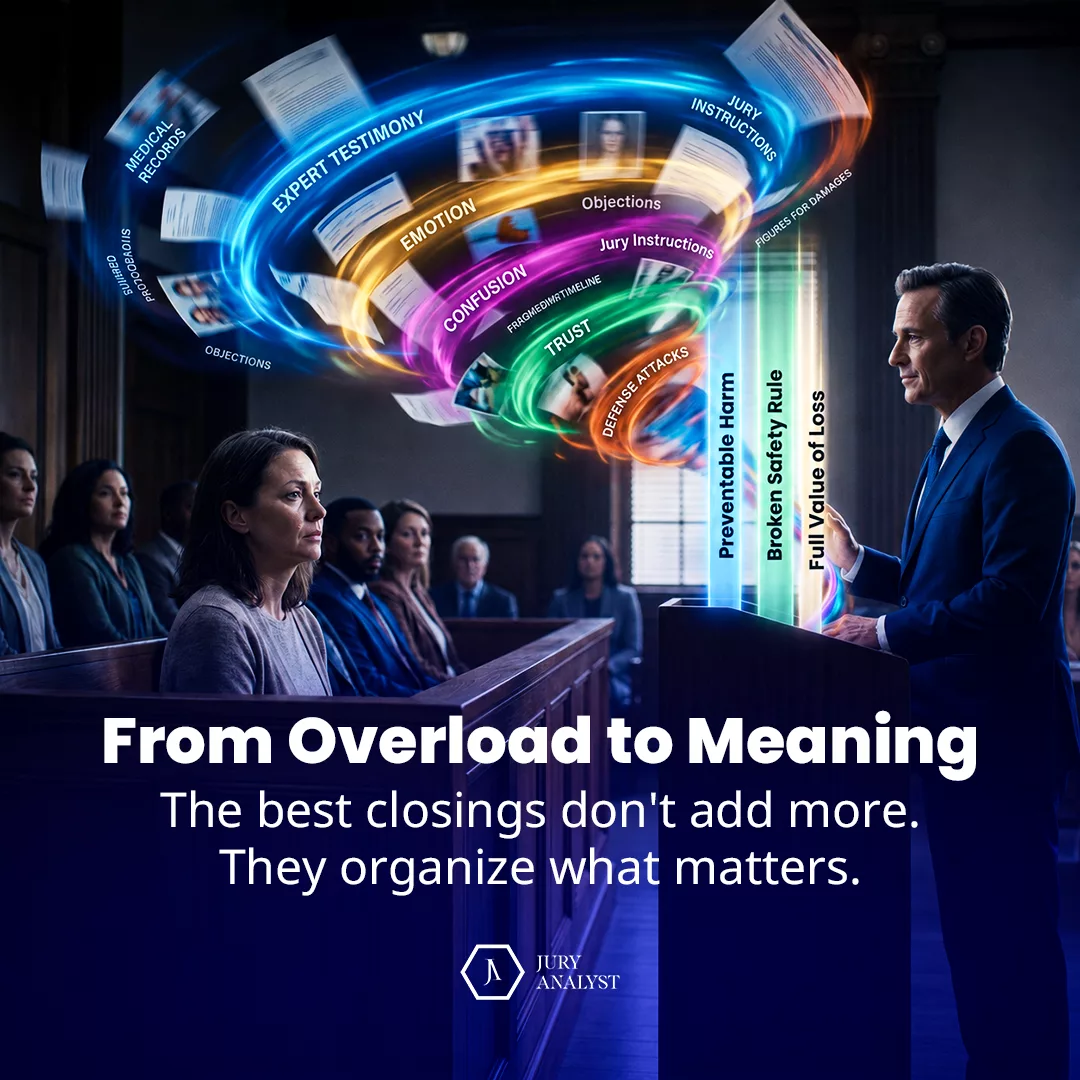
By the time closing begins, jurors are not blank slates. They are tired. They are saturated with testimony. They have heard experts contradict one another. They have watched both sides fight over records, timelines, medicine, safety rules, corporate conduct, and money. They have their own lives waiting outside the courthouse.
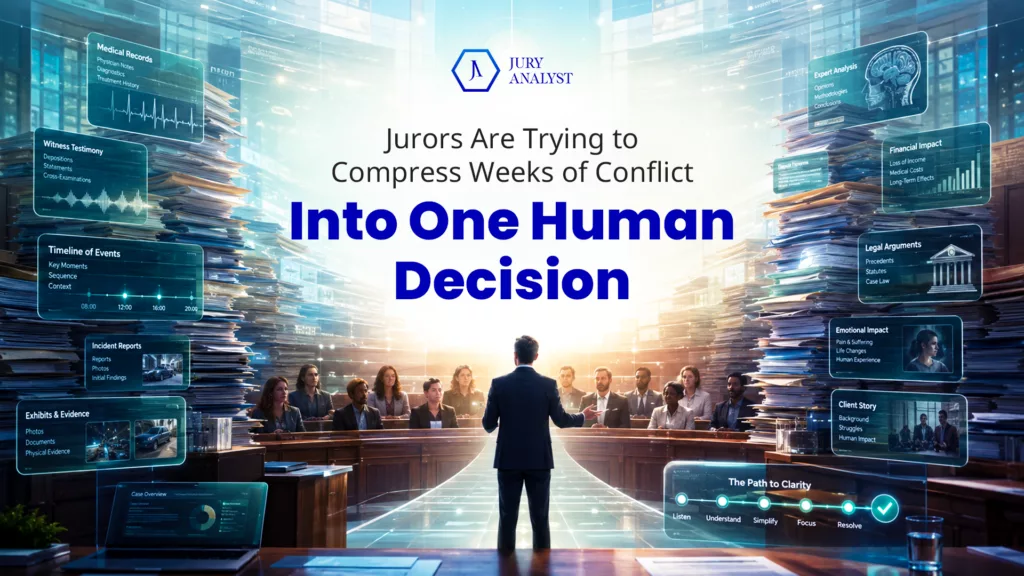
And now, in the final stretch, they are being asked to organize weeks of conflict into one decision.
That is why closing argument is not simply a summary of evidence.
It is a psychological event.
The Closing Argument Perception Gap
We call this the closing argument perception gap: the difference between what the trial team believes it is communicating and what jurors actually absorb, trust, remember, and repeat.
That gap is where strong cases become vulnerable.
Plaintiff trial teams live with a case for months or years. They know the facts, the medicine, the documents, the deposition answers, the defendant’s conduct, and the sequence of failures that made the harm preventable.
Jurors do not have that luxury. They are trying to make sense of the case in real time, under pressure, with limited memory and competing explanations.
A trial lawyer may see closing as the final proof structure. Jurors experience it as the final meaning-making moment.
They are not just asking, “Did the plaintiff prove duty, breach, causation, and damages?”
They are asking:
- Who should I believe?
- What really happened here?
- What does this say about responsibility?
- What am I being asked to do?
- Can I defend this decision in the deliberation room?
When a closing assumes jurors already understand the legal architecture, it can accidentally increase confusion instead of resolving it. And when jurors feel confused, they often do not blame themselves.
They blame the lawyer. Confusion creates friction, friction lowers trust, and once trust drops, even strong evidence can begin to feel uncertain.
Friction Point 1: Cognitive Load
The obvious risk in closing is disorganization.
But for sophisticated plaintiff lawyers, the more common risk may be an overly complex closing — one that tries to include every fact, answer every defense attack, and explain every legal or technical detail in full.
That kind of closing may prove the lawyer knows the case, but it may fail to help jurors carry the case into deliberations. Jurors cannot bring every fact with them; they need compression.
That does not mean dumbing the case down. It means translating complexity into meaning.
In a medical negligence case, jurors may not remember every clinical term, timestamp, or expert distinction. But they can remember:
“The hospital had three chances to prevent this, and each time, the system failed the patient.”
In a premises case, jurors may not remember every maintenance log. But they can remember:
“The danger was known, the fix was simple, and the choice not to fix it put everyone at risk.”
In a product case, jurors may not remember every engineering detail. But they can remember:
“The company knew the safer design existed and chose the cheaper risk.”
That is the difference between legal proof and jury proof.
Legal proof satisfies the structure. Jury proof gives human decision-makers a story they can understand, remember, and repeat.
Friction Point 2: Juror Worldview Bias
No juror hears a closing argument in isolation.
Every word passes through a private filter built from life experience, beliefs, fears, frustrations, family history, work history, money stress, attitudes about lawsuits, and assumptions about personal responsibility.
That means the same sentence can land in radically different ways.
One juror hears accountability. Another hears blame.
One juror hears a necessary verdict. Another hears an excessive demand.
One juror hears a corporation cutting corners. Another hears someone refusing to take responsibility for their own choices.
This is why plaintiff persuasion cannot rely on one emotional lane.
A closing built entirely around sympathy may move high-empathy jurors and alienate skeptical jurors. A closing built entirely around technical proof may satisfy analytical jurors and leave emotionally driven jurors cold. A closing built entirely around anger may energize some jurors and create resistance in others.
The strongest plaintiff closings do not water everything down into neutral language. Neutral arguments rarely move anyone.
Instead, they build bridges.
For the empathy-driven juror, the closing makes the human harm impossible to ignore. For the rules-based juror, it shows the defendant violated a basic community safety rule. For the skeptical juror, it provides objective anchors. For the damages-resistant juror, it explains the number with structure, confidence, and moral clarity.
The goal is not to manipulate jurors.
The goal is to remove unnecessary resistance so the evidence can actually be heard.
Friction Point 3: Damages Discomfort
Jurors may not consciously track how many minutes a lawyer spends on each part of the closing.
But they feel it. If a lawyer spends most of the closing defensively responding to liability attacks, then rushes through damages at the end, the jury receives a clear signal: the money makes the lawyer uncomfortable.
That signal is dangerous.
If the plaintiff lawyer cannot confidently talk about the full value of the harm, why should the jury confidently award it?
Damages cannot feel like an afterthought. They cannot be treated like a necessary but awkward conclusion. And they cannot be introduced with apology, hedging, or discomfort.
Phrases like these create friction:
- “I know this sounds like a lot of money.”
- “We are not asking for a windfall.”
- “Whatever you think is fair.”
Those lines may feel humble. But to a juror, they can sound like uncertainty.
A plaintiff lawyer asking for meaningful damages has to own the number.
That does not mean being theatrical. It does not mean being inflated. It means showing the jury how the number connects to the lived harm, the future harm, the medical reality, the pain, the disability, the daily consequences, and the defendant’s responsibility.
A strong damages argument gives jurors permission to do something difficult.
Because awarding money for human harm is psychologically hard.
Jurors know money will not bring back health, time, mobility, independence, or peace. That can make the verdict feel uncomfortable unless the lawyer gives them a clear framework for why the money matters.
The money is not a prize, a bonus, or sympathy. It is the civil justice system’s only available measure of accountability.
That has to be said clearly, confidently, and without apology.
Friction Point 4: Defense Framing
Plaintiff lawyers often face a difficult strategic tension in closing.
If they spend too much time answering the defense, they risk centering the defense’s narrative. If they ignore the defense, they risk looking evasive.
The answer is not avoidance. It is context.
Jurors heard the defense’s attacks. They remember the uncomfortable facts. They know the bruises in the case exist. Pretending otherwise damages credibility.
But bruising facts do not have to control the story.
They have to be placed in the right frame.
If the defense emphasizes a preexisting condition, the plaintiff lawyer should not hide from it. The lawyer should explain it.
Yes, there was a prior condition.
But it was stable. It was manageable. It did not stop this person from working, parenting, moving, living, or functioning.
The defendant did not create a perfectly healthy person’s vulnerability. The defendant took a manageable condition and turned it into something permanent, painful, and life-altering.
That is not evasion. That is meaning.
The defense wants isolated facts. The plaintiff lawyer must restore the full human context.
Friction Point 5: Narrative Compression
The true audience for closing is not only the jury sitting silently in the box.
It is also the future jury inside the deliberation room.
That is where the closing either survives or collapses.
A favorable juror may believe your case. But belief alone is not enough. That juror has to be able to explain your case to someone else.
They need language. They need structure. They need a simple way to respond when a skeptical juror pushes back.
That is why a closing must pass the retell test.
- Can a juror summarize the core case in two or three sentences?
- Can they repeat the safety rule?
- Can they explain why the defendant’s choice mattered?
- Can they connect the harm to the verdict?
- Can they defend the number?
If the answer is no, the closing may be too complex to survive deliberation.
This is where power phrases matter.
A power phrase is not a slogan. It is a portable piece of reasoning.
Examples:
- “Safety rules only matter if they are enforced.”
- “A preventable danger is not an accident.”
- “You do not get to ignore the risk and then blame the person who got hurt.”
- “When a company chooses the cheaper danger, the community pays the price.”
- “The question is not whether she was vulnerable. The question is why the defendant made that vulnerability catastrophic.”
These phrases give favorable jurors something they can carry — not because they replace evidence, but because they organize it.
Friction Point 6: Delivery Trust
A closing argument can be strategically sound on paper and still fail in the room.
Why? Because jurors do not only evaluate words. They evaluate the person delivering them.
Tone, pacing, eye contact, restraint, silence, movement, demonstratives, and emotional calibration all shape trust.
If the lawyer appears performative, jurors may admire the speech but reject the sincerity. If the lawyer appears angry before the evidence earns the anger, jurors may feel pushed. If the lawyer reads too much, jurors may feel disconnected. If the lawyer fumbles with technology, jurors may lose the thread.
The best delivery feels grounded. Not flat, not theatrical, but credible and controlled.
The lawyer is not performing outrage. The lawyer is expressing moral clarity.
The lawyer is not begging for sympathy. The lawyer is guiding responsibility.
The lawyer is not showing off command of the record. The lawyer is helping jurors understand what the record means.
That distinction matters.
Jurors are highly sensitive to authenticity. They may not be able to name exactly what feels wrong, but they can feel when a lawyer is overacting, hiding discomfort, or forcing emotion.
A great closing does not make the lawyer the center of the story.
It makes the jury understand why their decision matters.
The War Room Can Create a Dangerous Illusion
One of the biggest risks in trial preparation is internal agreement.
Everyone in the room knows the case. Everyone understands the facts. Everyone has lived with the strategy. Everyone nods when the theme is repeated. Everyone knows why the damages number is justified.
That can create the illusion of external validation.
But the jury has not lived inside the war room.
What feels obvious to the trial team may feel confusing to a juror. What feels emotionally powerful to the lawyer may feel excessive to a skeptical persona. What feels like a strong damages anchor may include subtle hedging the lawyer does not even notice. What feels like a clean liability story may require too much background knowledge to survive deliberation.
That is why modern plaintiff trial teams need more than internal confidence.
They need juror-centered pressure testing.
Closing argument preparation should not only ask:
“Do we like this?”
It should ask:
- How will different juror personas hear this?
- Where will they resist?
- What will confuse them?
- What will they remember?
- What will they repeat?
- Where does the lawyer sound defensive?
- Where does the damages request lose force?
- Which jurors are being brought along, and which are being left behind?
That is the value of a closing analysis framework.
The point is not to replace the lawyer, generate a canned argument, or predict a verdict with false certainty. It is to hold up a mirror before it is too late.
Closing Argument Analysis: Find the Friction Before the Jury Does
With Jury Simulator’s closing analysis capability, trial teams can evaluate a closing argument before jurors ever hear it.
The purpose is not to sanitize the lawyer’s voice. It is to protect it.
A strong analysis can help identify whether the argument’s intended theme is actually being reinforced throughout the closing, or whether it appears once and disappears.
It can evaluate whether too much time is being spent defensively answering the other side while damages are rushed.
It can flag hedging language that weakens the monetary ask.
It can surface where the story may be too complex to retell.
It can test how the argument may land across different simulated juror personas, including skeptical, analytical, high-empathy, or personal-responsibility-oriented profiles.
That is where the insight becomes practical.
If a skeptical juror persona rejects the damages anchor, the team can strengthen the objective structure.
If a personal responsibility persona blames the plaintiff, the team can reframe the defendant’s conduct around rule violation and community safety.
If a high-empathy persona connects emotionally but cannot explain liability, the team can sharpen the retell structure.
If the closing depends on a theme that jurors cannot remember, the team can build repetition and bookending into the final version.
If the lawyer sounds apologetic about money, the team can rewrite the ask before it reaches the courtroom.
That is the difference between hoping a closing works and knowing where it may break.
The Final Question Is Not “Was It a Good Speech?”
For plaintiff trial lawyers, the stakes of closing are too high to evaluate it only as performance.
The better question is:
- Will jurors hear a clear story of accountability — or a complicated lecture?
- Will they hear a confident damages framework — or discomfort around the number?
- Will they hear the defense attacks placed in context — or wonder why the plaintiff avoided them?
- Will they feel guided — or overwhelmed?
- Will favorable jurors be armed for deliberation — or left with only a general sense that the plaintiff deserved better?
A closing argument is the last major opportunity to shape how jurors organize the case before they are alone.
It is where evidence becomes meaning.
It is where harm becomes value.
It is where responsibility becomes action.
And in the modern courtroom, where jurors are tired, skeptical, distracted, and filtering everything through deeply human biases, the most persuasive lawyers are not merely the most eloquent.
They are the ones who understand what is happening beneath the surface.
They listen for the silence in the room. They anticipate the doubt before it becomes a vote. They simplify without weakening. They anchor without apologizing. They translate legal architecture into human meaning.
That is what jurors need during closing.
Not a blueprint.
A reason to walk through the front door.
Listen to the Science of Justice Podcast
We explore this topic further on the Science of Justice podcast, including:
- Why strong legal proof can still fail without perception testing
- How jurors interpret closing arguments through fatigue, bias, and cognitive load
- Why damages discomfort can weaken even a well-supported ask
- How plaintiff teams can identify hidden resistance before jurors enter deliberation
- Why the strongest closings are built to be remembered, repeated, and defended