
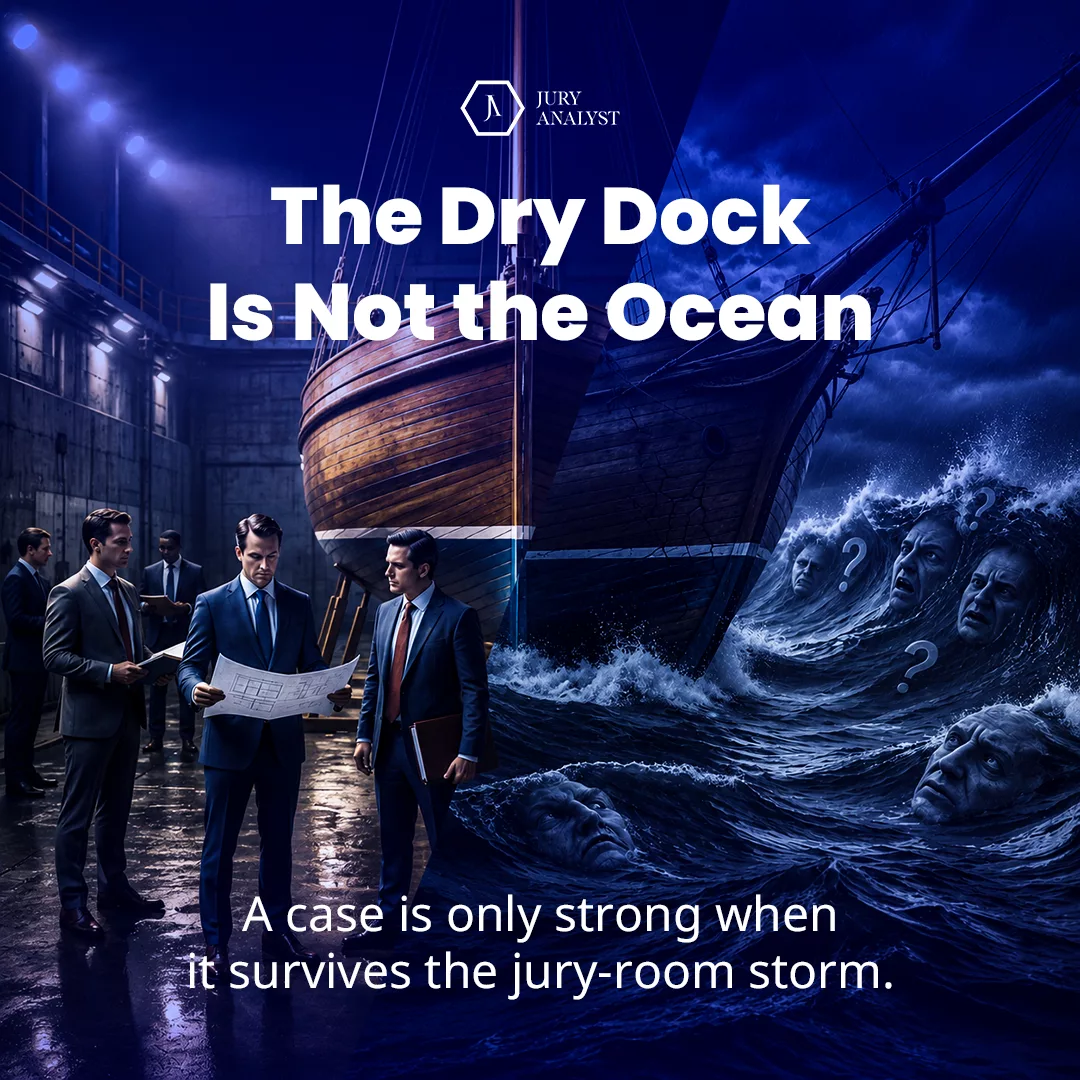
Why Strong Plaintiff Cases Still Fail When Juror Perception Goes Untested
A plaintiff case can look exceptionally strong inside the firm and still lose force in front of a jury.
The facts are organized. Liability appears clear. Medical records support the damages model. Experts are qualified. The trial team understands the theory of the case.
But jurors do not experience the case from inside the war room.
They do not begin with pleadings, discovery responses, or expert reports. They begin with perception.
They begin with trust.
Jurors ask questions lawyers sometimes underestimate:
- Does this story feel believable?
- Does the plaintiff seem responsible?
- Does the defendant’s conduct feel unreasonable?
- Does the harm feel connected to the conduct?
- Does the accountability sought feel fair?
This is where strong plaintiff cases become vulnerable.
Because the internal version of the case is not the final test.
The real test begins when people with no legal training organize the facts for themselves.
That is where hidden risk appears.
That is where value shifts.
That is where otherwise strong cases begin to weaken.
The Visible Case vs. The Perceived Case
Most trial teams spend the majority of their time building the visible case.
The visible case includes:
- Liability theories
- Medical evidence
- Expert opinions
- Depositions
- Damages models
- Trial themes
- Witness preparation
- Demonstrative evidence
This work matters. A plaintiff team still has to prove the case.
But jurors evaluate something different alongside the legal framework.
They evaluate the perceived case.
The perceived case includes:
- Who feels trustworthy
- What conduct feels reasonable
- Which facts create suspicion
- Whether responsibility feels proportionate
- What explanations seem incomplete
- Whether the plaintiff appears accountable
- Which side feels more credible overall
This is the case beneath the case.
And this is where many plaintiff teams miscalculate risk.
Because the danger is not always weak evidence.
The danger is a legally strong case paired with unstable human interpretation.
A trial team may see a clear breach of duty.
A juror may see a plaintiff who made questionable choices.
A trial team may see a highly qualified expert.
A juror may see an arrogant witness being paid to testify.
A trial team may see a complete explanation.
A juror may feel the story still does not make sense.
Those differences matter because jurors do not process facts in the same sequence lawyers build them.
Jurors organize facts around meaning.
Why Jurors Rebuild the Story
Jurors do not passively absorb information.
They actively rebuild the narrative in real time.
They compare testimony to personal experience. They test conduct against their own standards. They look for missing pieces. They fill gaps with assumptions.
And when the plaintiff team leaves ambiguity unresolved, jurors often create their own explanation.
That explanation may never be spoken aloud in court.
It still shapes deliberation.
Example: The Slip-and-Fall Problem
Consider a slip-and-fall case where:
- The floor was wet
- The defendant knew about the hazard
- No warning sign was posted
- The plaintiff suffered documented injuries
Legally, the case appears strong.
But then one detail changes the perceived case:
The plaintiff was wearing flip-flops inside a warehouse.
The legal team focuses on the unsafe condition.
A juror focuses on personal responsibility.
One skeptical juror thinks:
“I would never wear flip-flops in a warehouse.”
That single thought changes the center of gravity in the case.
Now the juror is no longer evaluating only the defendant’s conduct. The juror is evaluating the plaintiff’s judgment.
The defense may not even need to fully develop the counter-story.
The juror already has.
This is why seemingly minor details require perceptual testing early.
A fact with limited legal relevance can carry enormous moral relevance inside deliberations.
Legal Strength Does Not Automatically Create Credibility
Lawyers often evaluate witnesses through credentials.
Jurors evaluate witnesses through behavior.
An expert may have decades of experience, board certifications, publications, and technically correct opinions.
But if that witness appears impatient, evasive, overly polished, or condescending, jurors stop hearing expertise.
They start hearing bias.
Jurors define knowledge differently than lawyers do.
To lawyers, expertise often means education, specialization, and experience.
To jurors, expertise often means clarity.
A witness who teaches clearly earns trust.
A witness who hides behind jargon creates suspicion.
The same applies to confidence.
Calm and steady communication builds credibility.
Over-explaining, defensiveness, or visible frustration creates doubt.
Substance matters.
But delivery determines whether jurors accept the substance.
A witness does not simply testify to facts.
A witness teaches jurors how to feel about those facts.
The Danger of Internal Fluency
One of the biggest risks in plaintiff litigation is internal fluency.
Over time, trial teams become deeply familiar with the case:
- The timeline feels obvious
- The damages story feels coherent
- The liability theory feels settled
- The documents appear self-explanatory
That familiarity improves preparation.
It also creates blind spots.
The team understands context jurors do not have.
The team sees connections jurors may never make.
The team has already accepted explanations jurors are hearing for the first time.
As a result, the case begins to feel clearer inside the firm than it actually is.
Jurors experience the case cold.
They simplify quickly.
They focus on different details.
They decide what matters early.
And often, the issues they fixate on are not the issues the legal team prioritized.
A timeline gap becomes the issue.
A witness’s tone becomes the issue.
A plaintiff’s decision becomes the issue.
A single phrase from a deposition becomes the issue.
By the time those problems emerge at trial, strategic flexibility is limited.
That is why effective plaintiff teams pressure-test perception before strategy hardens.
Why Themes Collapse Under Resistance
Some plaintiff themes sound persuasive internally but fail under skeptical review.
This happens when a theme asks jurors to accept too much.
For example, in a workplace injury or product liability case, a theme centered on intentional corporate harm may create resistance.
Most jurors do not naturally believe a company deliberately wanted someone injured.
But a theme focused on decision-making is often more durable:
The company prioritized speed and production over basic safety.
That framing feels more realistic to jurors because it aligns with conduct they already recognize in everyday life.
Strong themes survive skepticism.
Weak themes require excessive agreement.
That is why plaintiff teams should test themes before mediation and trial, not after.
The goal is not simply predicting verdicts.
The goal is identifying where the story breaks under pressure.
Strong plaintiff teams ask:
- Which facts create skepticism?
- Where will jurors blame the plaintiff?
- Which witness creates friction?
- Which explanation feels incomplete?
- Which defense argument sounds more believable than expected?
- Which theme feels lawyer-created instead of human?
Those answers reshape strategy long before trial begins.
Why Early Testing Changes Outcomes
The earlier perception testing begins, the more valuable it becomes.
At Intake
Testing reveals more than legal viability.
It answers critical strategic questions:
- Does the story make intuitive sense?
- Where does skepticism begin?
- Does the emotional harm translate?
- Which facts immediately create resistance?
During Discovery
Testing helps teams gather evidence that closes narrative gaps, not just legal gaps.
If jurors are likely to question the plaintiff’s decisions, discovery should develop context around those decisions.
If jurors may distrust damages claims, the team should gather behavioral proof showing real-world impact.
If jurors may sympathize with the defense, discovery should uncover documents, communications, or testimony that reveal ignored risks and poor decision-making.
During Witness Preparation
The issue is no longer simply:
“Is the witness correct?”
The issue becomes:
“Will jurors trust the witness enough to believe the explanation?”
During Mediation
Testing creates more disciplined risk evaluation.
An organized case is not necessarily a resilient case.
A resilient case is one that has already survived outside skepticism before the stakes become final.
Every Plaintiff Case Has a Counter-Story
Every case contains a competing narrative.
Sometimes the defense builds it.
Sometimes jurors build it themselves.
Strong plaintiff teams identify it first.
That means asking difficult questions early:
- What fact will skeptical jurors use against us?
- Where does the timeline invite speculation?
- Which witness creates distrust?
- Which damages claim feels inflated?
- Which explanation sounds incomplete?
- What makes the defense conduct appear reasonable?
- What would someone who disagrees with us say after hearing only the basic facts?
These questions do not weaken a plaintiff case.
They strengthen it.
Because a case becomes more durable when resistance is identified before the courtroom exposes it.
What Strong Plaintiff Teams Do Differently
Modern plaintiff strategy requires more than confidence in the evidence.
It requires disciplined attention to how the evidence will actually be received.
Facts matter.
Experts matter.
Story matters.
Credibility matters.
But the case jurors hear is not always the case lawyers believe they built.
Strong plaintiff teams do not wait until trial to discover how outsiders interpret the story.
They:
- Test the case before strategy hardens
- Identify hidden resistance early
- Pressure-test witnesses
- Refine themes before mediation
- Close narrative gaps before jurors fill them
- Build around how real people assign responsibility
Because the ultimate question is not whether the case works inside the firm.
The question is whether the case survives the jury room.
Listen to the Science of Justice Podcast
We explore this topic further on the Science of Justice podcast, including:
- Why strong legal proof still fails without perception testing
- How jurors build counter-stories from missing facts
- Why credibility often outweighs technical precision
- How plaintiff teams can identify hidden resistance before trial