
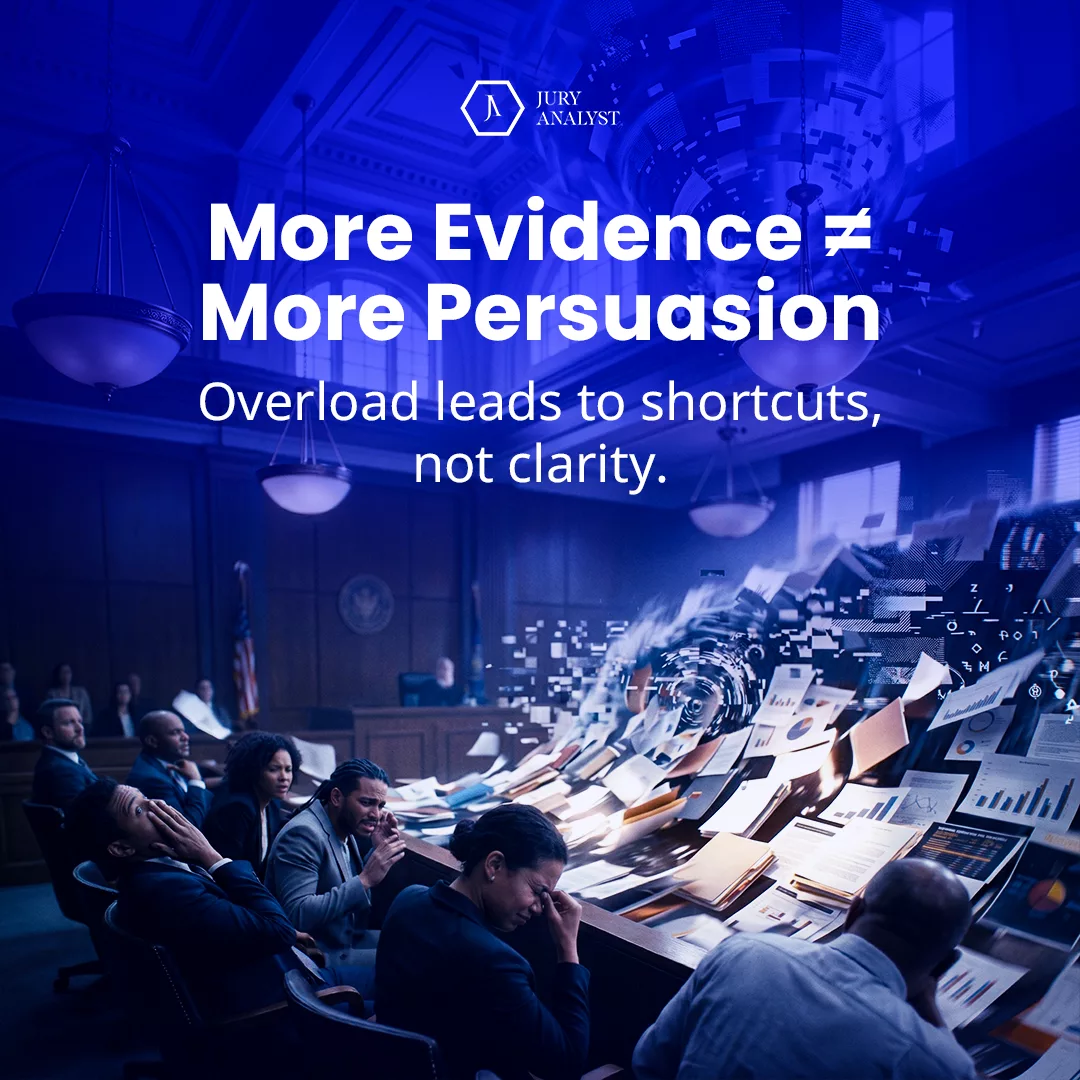
Plaintiff trial teams do not usually lose because they missed the law.
They lose because they mistook internal agreement for external persuasion.
That distinction matters more than most teams want to admit.
Inside a firm, a case can feel settled long before it ever reaches a courtroom. The facts line up. The timeline works. Liability appears strong. Damages feel supported. The experts reinforce the theory. The team has spent months inside the file, pressure-testing details, refining language, and building confidence.
By the time trial approaches, the case can feel obvious.
But obvious to whom?
That is where some of the most consequential strategic mistakes begin.
The Problem Is Not the Case File
Most plaintiff lawyers are trained to evaluate cases through disciplined legal structure.
Was there a duty? Was there a breach? Can causation be shown? Are damages supported?
That framework is necessary. It is how legal arguments are built.
But jurors are not legal processors. They are interpreters.
They do not experience a case as a checklist. They experience it as a sequence of impressions. They respond to clarity, emotional coherence, credibility, and fairness. They are constantly asking themselves questions that are rarely written on a whiteboard in the war room:
Do I believe this person? Does this feel connected? Is this amount too much? Is something being overstated? Who feels more reasonable here?
That is why a case can be technically strong and still underperform.
Not because the evidence failed.
Because the evidence was never the only thing being judged.
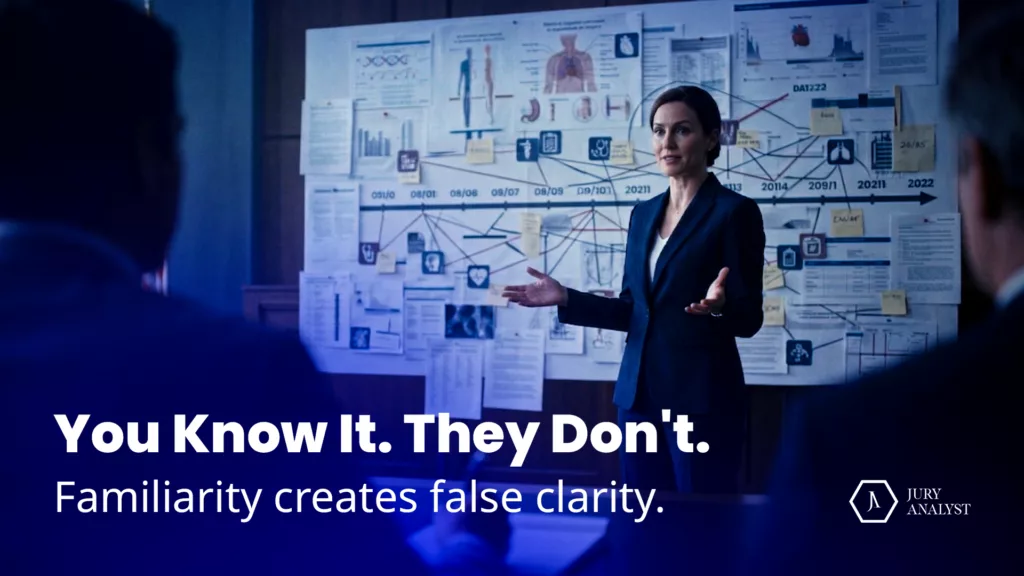
Trial Teams Often Confuse Fluency With Persuasion
The more a team lives inside a case, the easier that case becomes to understand.
That ease is dangerous.
Once lawyers know the records, know the sequence, know the medicine, know the personalities, and know where the weak spots supposedly are, they stop experiencing the case the way a jury will. What feels clear to the team may only feel clear because the team has been immersed in it for months or years.
Jurors do not arrive with that familiarity.
They encounter the case cold. They absorb it in fragments. They carry none of the team’s built-in assumptions. They are processing not only what is said, but how hard it is to follow, how credible it feels, and whether the ask matches their sense of proportionality.
That means a case can be well constructed and still poorly received.
Those are not the same thing.
Jurors Do Not Score Cases as a Whole
One of the biggest strategic errors in plaintiff work is treating case strength like a single condition.
Strong. Weak. Good. Bad. Triable. Valuable.
Jurors do not think that way.
They react to separate dimensions that influence each other in unpredictable ways.
They may believe the defendant acted badly but still feel unsure that the harm was fully caused by that conduct. They may accept liability but recoil at the damages ask. They may feel sympathy for the plaintiff but question whether the presentation is too polished, too flat, too angry, or too rehearsed.
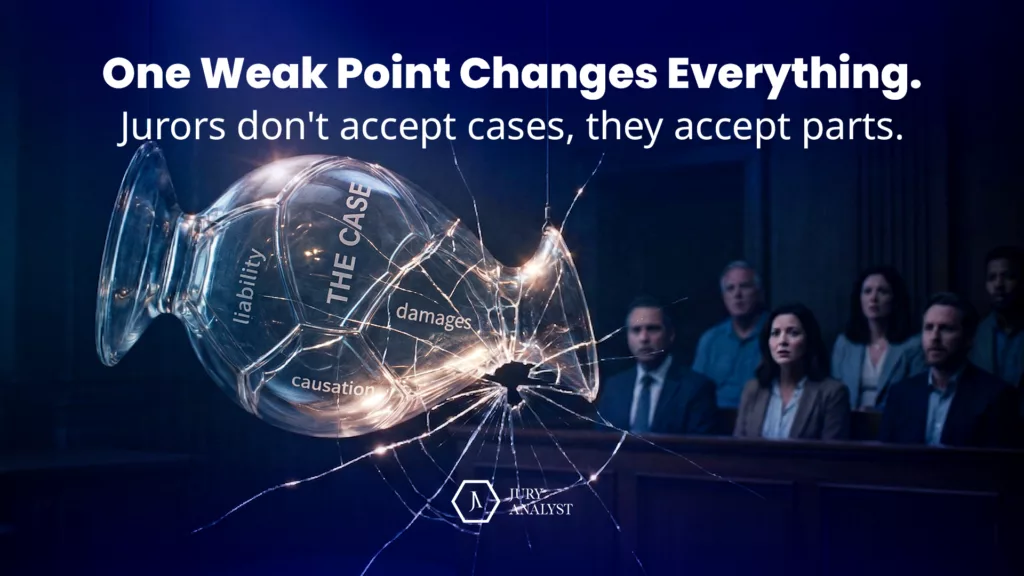
In other words, jurors do not buy “the case.”
They accept or reject parts of it, and then those parts start influencing one another.
A single unstable component can alter the meaning of everything around it.
Where Cases Quietly Start to Slip
Underperformance often begins with things that do not seem fatal when viewed internally.
A treatment gap the team feels can be explained. A plaintiff who comes across as decent but not especially compelling. A damages frame that sounds justified in prep but feels oversized in deliberation. A technical explanation that is accurate but too mentally taxing to hold onto. An expert who is qualified on paper but difficult to trust in tone.
None of these always kills a case.
But they do something important. They change how jurors organize what they are seeing.
That is the real issue.
Jurors are not simply collecting evidence. They are building meaning from signals. Once a signal starts working against you, the juror does not isolate it neatly. It bleeds outward. It changes how they hear the next witness, how they interpret the prior record, and how much benefit of the doubt they are willing to give.
That is why so many disappointing outcomes feel confusing after the fact.
The team is still thinking about what was proven.
The jury was deciding what felt believable.
Why “More Evidence” Often Makes the Problem Worse
Lawyers are trained to fortify.
If liability is challenged, add more support. If causation is contested, go deeper into the medicine. If damages are resisted, document more suffering.
Sometimes that helps.
Sometimes it overloads the jury.
A jury under cognitive strain does not become more analytical. It often becomes more reductive. When too much information arrives too quickly, people start simplifying. They fall back on shortcuts. They search for the easiest organizing principle available.
That is where complex cases start to drift.
If the science is dense, jurors may default to appearance. If the records are overwhelming, they may default to suspicion. If the damages framework is aggressive, they may default to resistance.
Once that happens, the story the team intended to deliver is no longer the story being used to decide the case.
The Jury Room Is Where Polished Strategy Meets Social Reality
Even a case that lands reasonably well in trial can still erode in deliberation.
That is because deliberation is not a reading of verdict forms. It is a social event.
Some jurors dominate. Some retreat. Some want moral clarity. Some want restraint. Some are moved at first, then become uncertain once challenged. Some are never truly persuaded, but stay quiet until the room narrows.
This is where a lot of plaintiff persuasion weakens.
Not because the argument was bad.
Because the argument was difficult for sympathetic jurors to carry on their own.
If a favorable juror cannot restate the theory simply, defend the damages ask cleanly, and answer the obvious skeptical questions without collapsing into confusion, the case begins losing force after closing, not before it.
That matters more than most teams measure.
Experience Still Matters. It Just Cannot Be the Only Instrument
None of this is an argument against trial experience.
Experienced plaintiff lawyers know things that cannot be learned from theory alone. They recognize danger sooner. They hear tone better. They understand rhythm, sequence, and pressure.
But experience has limits when it is asked to do predictive work by itself.
Past verdicts are frozen moments. Juror perception is not.
Every venue carries its own attitudes about accountability, institutions, money, injury, fairness, and personal responsibility. And those attitudes do not stay still. They shift with time, culture, economics, local history, and community sentiment.
So the question is no longer whether your team has seen cases like this before.
The better question is whether this jury, in this venue, at this moment, will process this case the way your team expects.
That is a different standard.
The Better Strategic Question
A lot of case evaluation still begins with some version of this:
Does this case make sense?
It is not a useless question. But it is an incomplete one.
A stronger question is this:
What happens to this case when it leaves the people who know it best?
That shift forces a different kind of discipline.
It makes teams look beyond internal coherence and toward external reception. It moves focus away from whether the theory is elegant and toward whether the theory survives human interpretation. It asks not only whether the evidence is powerful, but whether it stays powerful once filtered through fatigue, skepticism, group dynamics, and deliberation pressure.
That is where modern plaintiff strategy has to become more exact.
Final Thought
Some cases do not fail in the courtroom.
They fail earlier, at the moment the team decides its own confidence is enough.
That is the danger.
Because jurors are not there to validate the logic that made sense inside the firm. They are there to decide what the case meant to them.
And if those two things are not aligned, the result is often not total collapse. It is something more frustrating.
A good case that lands small. A strong liability story that produces a weak number. A file that looked trial-ready but never became jury-ready.
That is the distinction plaintiff teams need to take seriously.
Want the deeper version?
This article draws from our latest Science of Justice episode, where we go deeper into why strong cases stall, shrink, or break once real juror psychology enters the picture. The discussion covers cognitive overload, narrative breakdown, persuasion inside deliberations, and why internal case confidence is often a poor proxy for jury response.
If this topic is on your mind heading into a high-exposure case, listen to the latest episode of Science of Justice, The Hidden Risk in “Strong” Cases, for the full conversation.