
Helping Jurors See the Invisible in Traumatic Brain Injury Cases
A traumatic brain injury case often begins with a single line in the medical record:
“CT scan: normal.”
To a juror, that sentence can sound like closure. Like certainty. Like the end of the story.
But for the person living with the injury, it is often only the beginning.
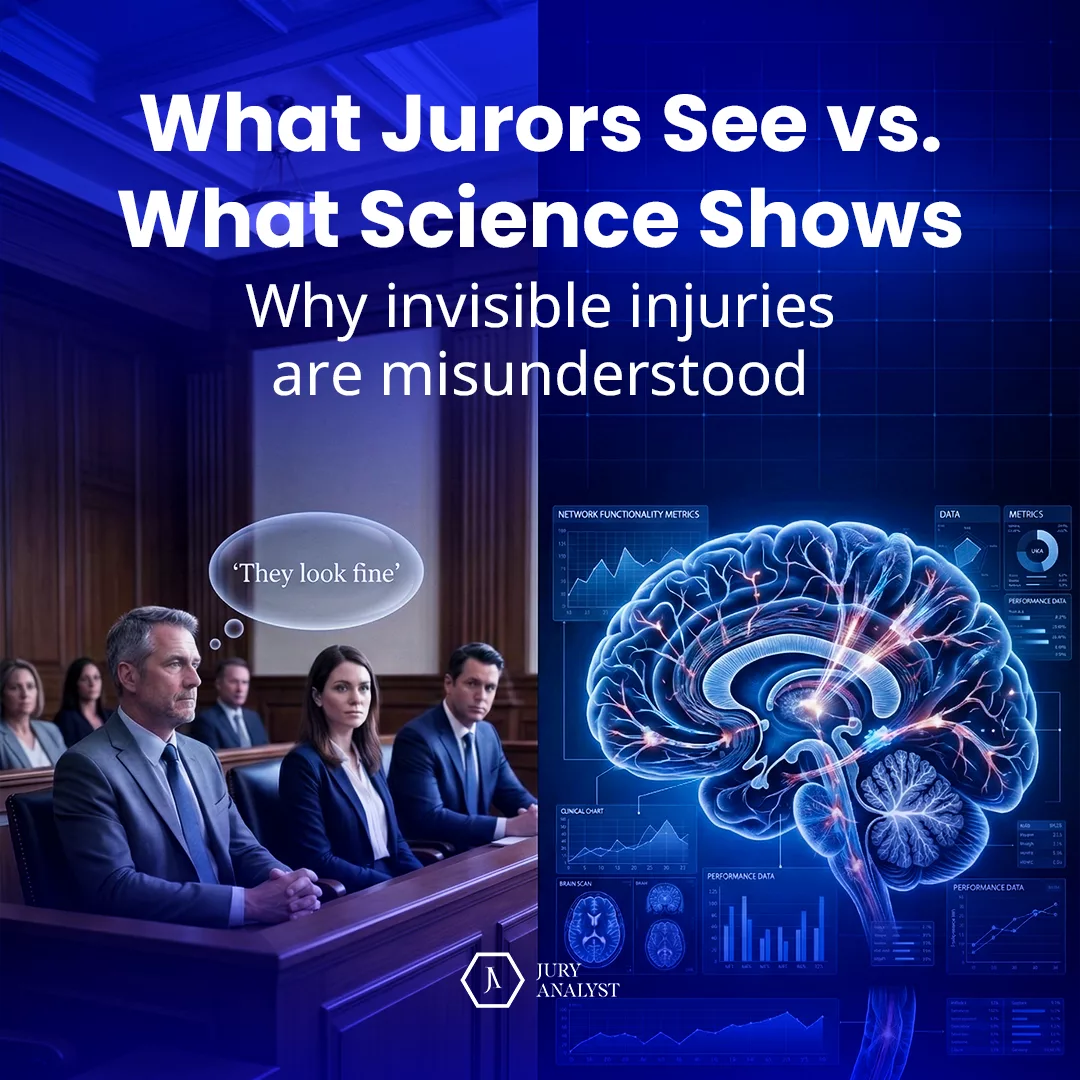
Across the country, plaintiff trial teams represent individuals whose lives have been profoundly altered by neurological trauma that cannot be seen on routine imaging. The plaintiff may walk into the courtroom, sit upright on the witness stand, and answer questions clearly for twenty minutes. To the untrained eye, they may appear fine.
Yet outside that courtroom, the reality is very different.
The person who once ran complex financial models for ten hours a day now collapses after two hours of mental effort. The teacher who once managed a classroom of children can no longer tolerate noise, light, or competing stimuli. The parent who once managed a household now struggles to remember simple tasks.
The scan may look normal.
The life does not.
And that disconnect—between medical reality and juror perception—is one of the most consequential challenges in modern traumatic brain injury litigation.
The Brain Injury Paradox
Over the past two decades, neurology and clinical neuropsychology have dramatically advanced our understanding of traumatic brain injury.
Physicians now understand that many TBIs are functional injuries rather than structural ones.
In other words, the brain’s physical structure may appear intact on CT or MRI imaging, while the brain’s communication pathways have been disrupted at a microscopic level.
This includes damage such as:
- Axonal shearing, where microscopic neural connections tear
- Disrupted neural signaling between brain regions
- Metabolic dysfunction in brain cells following trauma
- Neurochemical cascades that evolve weeks after injury
These changes often do not appear on routine imaging.
Yet they can profoundly alter how the brain works.
The result is a range of symptoms that are devastating—but frequently misunderstood:
- Cognitive fatigue
- Slowed processing speed
- Memory impairment
- Executive dysfunction
- Emotional regulation challenges
- Personality changes
For physicians and neuropsychologists, these patterns are well documented.
For jurors, they can be difficult to reconcile.
What Jurors See
Jurors rely heavily on visual cues when evaluating injury.
A broken bone can be seen. A surgical scar can be seen. A cast, a wheelchair, a brace—these signals confirm injury immediately.
Brain injuries rarely provide those signals.
Instead, jurors must interpret symptoms that may appear subtle:
- Difficulty concentrating
- Mental exhaustion
- Slowed thinking
- Irritability
- Emotional volatility
Without context, these symptoms can sound familiar.
A juror might think:
“I forget things sometimes too.” “I get tired after work.” “Everyone feels overwhelmed occasionally.”
What they are unknowingly doing is mapping a neurological injury onto everyday experiences.
This is a natural human response. Psychologists refer to these mental shortcuts as cognitive heuristics.
But inside a courtroom, those shortcuts can dramatically distort how injuries are evaluated.
When Intuition Replaces Science
When jurors encounter unfamiliar or invisible injuries, uncertainty rises.
And uncertainty is where human biases thrive.
Several common patterns frequently shape how jurors interpret brain injury evidence:
Availability Bias
Jurors compare the plaintiff’s symptoms to people they personally know. If they have never seen someone with a brain injury who “looks normal,” they may underestimate the severity.
Normalcy Bias
If someone appears outwardly healthy, jurors instinctively assume their condition must be minor.
Anchoring
Early impressions, such as “the scan was normal,” can shape how later evidence is interpreted.
Authority Bias
Jurors often rely on cues of credibility when evaluating experts, including confidence, clarity, and communication style.
These dynamics are not about fairness or bad faith.
They are about how human beings process uncertainty.
And in brain injury litigation, uncertainty is everywhere.
The Real Translation Problem
For plaintiff trial teams, the challenge is not simply presenting medical evidence.
It is translating that evidence into a form jurors can understand.
Neuropsychological test results alone rarely carry emotional weight.
For example:
A report may show a drop in working memory from the 90th percentile to the 15th percentile.
Clinically, that is devastating.
But to a juror, the number may feel abstract.
The jury does not live in percentiles.
They live in stories.
So the real task becomes translation.
What does that drop in working memory mean in a human life?
It might mean:
- A financial analyst who can no longer manage complex models
- A nurse who cannot track multiple patient needs simultaneously
- A teacher who cannot manage sensory overload in a classroom
- A parent who forgets commitments, conversations, and responsibilities
When neurological impairment is translated into observable changes in daily life, jurors can finally see what the scan cannot show.
The Danger of Assumption
For decades, trial preparation often relied on intuition.
Trial teams would gather in conference rooms and ask:
“Do you think a jury will understand this?”
Experienced lawyers would debate strategy based on past cases and instinct.
But there is a fundamental problem with that approach.
Lawyers are not jurors.
Trial teams spend months immersed in the medical records. They meet the injured person and their family. They see the impact of the injury firsthand.
Jurors enter the courtroom with none of that context.
They arrive with their own life experiences, their own skepticism, and their own mental shortcuts.
When a case strategy is built solely on intuition, trial teams risk discovering juror skepticism for the first time during deliberation.
That is a dangerous place to learn.
The Shift Toward Behavioral Trial Preparation
Modern plaintiff trial preparation is undergoing a significant evolution.
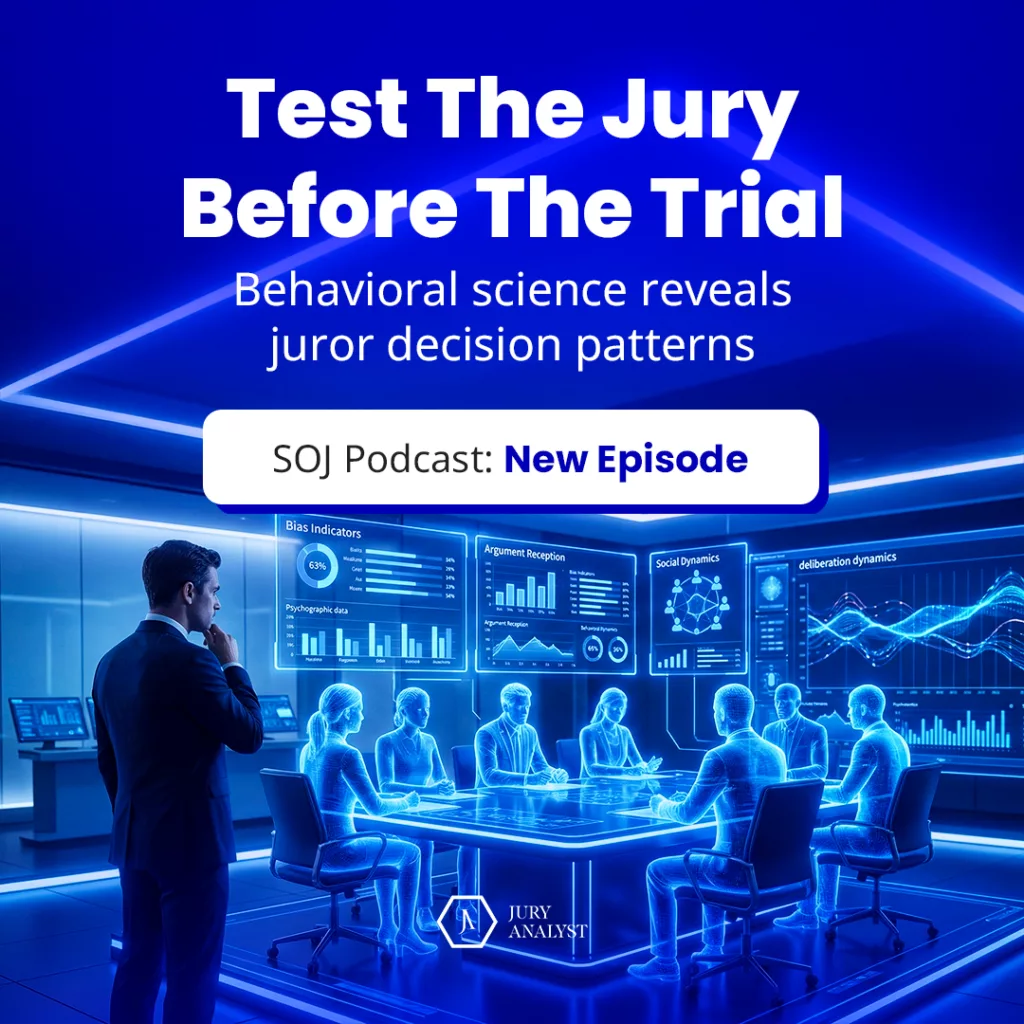
Rather than guessing how jurors might interpret complex injuries, sophisticated trial teams are beginning to test those assumptions before trial.
Behavioral research and structured juror analysis now allow attorneys to explore critical questions early:
- Do jurors assume a brain injury must appear on imaging?
- How do jurors interpret delayed symptom onset?
- Which explanations make cognitive fatigue understandable?
- Which analogies resonate and which fall flat?
- Which narratives build empathy versus skepticism?
When these questions are explored early, trial teams gain something invaluable:
Visibility into how the jury room may actually think.
Seeing the Case Through the Jury’s Eyes
One of the most powerful developments in trial preparation is the ability to evaluate cases through venue-specific juror perspectives.
Every jury pool brings its own attitudes, beliefs, and cultural expectations.
Some communities place heavy emphasis on personal resilience. Others show strong trust in medical authority. Others approach injury claims with skepticism.
Understanding those patterns can shape how a case is framed long before trial begins.
Through structured juror research and simulation environments such as Jury Simulator, trial teams can explore how different juror mindsets react to:
- medical testimony
- damages narratives
- symptom explanations
- delayed treatment timelines
- expert credibility signals
This allows attorneys to identify potential misunderstandings before they appear in a jury room.
The goal is not prediction.
The goal is preparation.
Turning Invisible Injuries Into Visible Truth
The central challenge in brain injury litigation will always remain the same:
Helping jurors understand what they cannot see.
When trial teams successfully translate the science of brain injury into real-world consequences, the story changes.
Jurors no longer see an abstract diagnosis.
They see a life altered.
They see:
- the engineer who can no longer sustain complex thinking
- the teacher overwhelmed by classroom noise
- the parent who cannot manage the cognitive load of everyday life
And when jurors truly understand those changes, damages are no longer abstract numbers.
They become recognition of loss.
A Critical Conversation Happening Right Now
These issues sit at the intersection of medicine, neuroscience, and trial advocacy.
That is why the conversation is gaining momentum across the medical-legal community.
At the TBI Med Legal Conference in March 2026, physicians, neuropsychologists, and plaintiff trial lawyers will gather to examine how modern brain science is reshaping the way traumatic brain injury cases are understood inside the courtroom.
Jury Analyst will be presenting sessions exploring how behavioral science and juror analytics can help trial teams close the gap between medical certainty and juror perception.
Topics include:
✔ How jurors interpret invisible injuries
✔ Where skepticism emerges in brain injury cases
✔ How expert communication shapes juror belief
✔ Testing damages narratives before trial
✔ Identifying psychological barriers early in a case
For trial teams handling traumatic brain injury litigation, these insights can fundamentally change how cases are evaluated and prepared.
The Future of Brain Injury Litigation
The courtroom is evolving.
The era when complex neurological injuries could rely solely on courtroom storytelling is fading.
Today’s most effective trial teams are combining:
- neuroscience
- behavioral science
- empirical juror research
- and structured case testing
to ensure jurors truly understand the injuries that cannot be seen.
Because in brain injury litigation, the difference between a case that feels strong and one that measures strong can determine everything.
Continue the Conversation
If your practice involves traumatic brain injury cases, this topic deserves deeper exploration.
Jury Analyst is currently working with plaintiff trial teams across the country to examine how jurors interpret invisible injuries, and how trial strategy can be refined long before trial begins.
Schedule a Strategy Session with Jury Analyst to explore how juror analytics and behavioral science can strengthen your next brain injury case.
And for a deeper discussion on the science behind these challenges, listen to the newest episode of the Science of Justice podcast:
“Invisible Injuries, Visible Justice: Transforming Brain Injury Litigation.”
Because when the scan is normal but the damage is real, the most important work in a brain injury case is helping the jury see what medicine already knows.