

Four techniques plaintiff attorneys must demand from any jury research platform and why most get it wrong.
Everyone is talking about using AI for trial preparation.
Consultants are adding “AI-powered” to pitch decks. Law firms are experimenting with generic LLM tools like ChatGPT to summarize transcripts or generate voir dire questions. The output often reads confidently and looks polished.
But confidence does not equal reliability.
Generic systems can produce persuasive analysis while relying on broad assumptions, overlooking venue-specific attitudes, and flattening the complex psychology that shapes real jury deliberations, in high-stakes litigation, that gap between polish and predictive validity matters.
At Jury Analyst, we’ve invested in the science behind jury behavior long before AI became part of the legal industry conversation. Over the past decade, we built the empirical foundation that responsible predictive modeling requires, conducting venue-specific Big Data Jury Research Studies with real jury-eligible respondents across jurisdictions, systematically and rigorously. JurySimulator is the result of that work. It translates more than ten years of validated juror data into a structured platform that allows attorneys to simulate deliberation dynamics, test strategic framing, refine witness presentation, and anticipate venue-specific biases. The data behind this platform was not assembled overnight. It was built with the long game in mind.”
The focus has always been on a disciplined, courtroom-ready application grounded in real juror behavior and statistical modeling, not on generic technology layered onto litigation.
When a client’s outcome depends on jury decisions, analysis cannot simply sound intelligent. It must be dependable.
The Real Risk: AI Without Litigation Context
General-purpose AI systems are trained on broad internet data. They are not designed around:
- Your specific venue
- Your case type
- Your damages framework
- Local jury attitudes
- Group deliberation behavior
They produce clean summaries and identify surface-level themes. What they lack is litigation context.
In civil trials, especially high-exposure cases, the difference between a solid verdict and an exceptional one often comes down to preparation details that are specific to jurisdiction and case structure.
The Proof Is in the Data
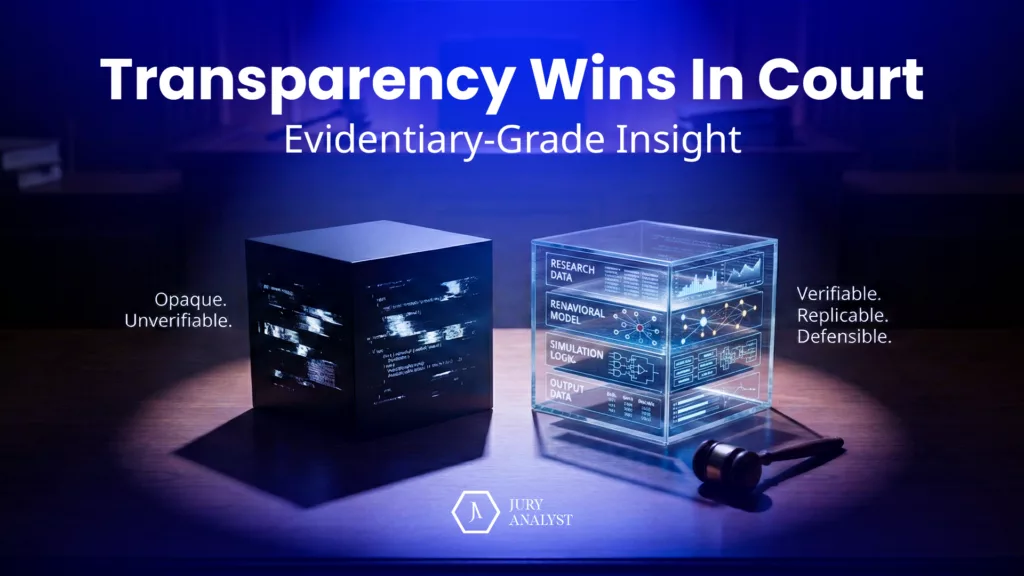
JurySimulator’s persona engine has been formally tested and validated across four independent phases. In repeated testing, our AI personas reached the same verdict conclusion every single time the same case was presented across multiple independent runs. We then compared 45 AI personas directly against 1,089 real human jurors across seven cases, and the decision patterns, demographics, and attitude profiles aligned closely with real venue populations.
Perhaps most importantly, 1,170 persona-generated text responses were evaluated for how human they actually sound, scoring near perfect across language realism, reasoning depth, and authentic bias expression. These are not sanitized, balanced AI responses. They reflect the kind of perspective-driven language a trial consultant would actually analyze.
The full validation report is available upon request following a demo session with our team.
Why General AI Struggles With Jury Research
Jury research is not linear. It is layered and contextual.
1. Juror responses can be contradictory
A prospective juror may express empathy for an injured plaintiff early in questioning and later show hesitation about damages. That tension is meaningful. It signals where resistance may develop during deliberations.
General AI systems often smooth those contradictions into a simplified narrative. Real juror behavior is rarely that straightforward.
2. Venue shapes decision-making
Juror attitudes vary significantly across counties and jurisdictions. Demographic similarities do not guarantee behavioral similarities.
Without venue-specific calibration, AI defaults to generalized assumptions that may not reflect your courtroom.
3. Personality affects deliberation dynamics
The Big Five personality dimensions influence how jurors process evidence, evaluate credibility, and interact with others in deliberation.
Understanding how high Conscientiousness interacts with lower Openness in a damages discussion requires structured modeling within a litigation-focused environment.
4. Written responses require interpretation
When a juror writes, “I can be fair,” that statement carries different implications depending on case type and psychological profile.
Without context, AI may label that response as neutral. With structured modeling, it becomes a starting point for strategic questioning.
Four Failure Modes and How JurySimulator Addresses Them
Failure Mode #1: Analysis Without Structured Inputs
General AI tools often generate analysis based on loosely defined prompts. The output may sound persuasive, but lacks defined litigation parameters.
JurySimulator operates within a structured framework:
- Upload your complaint and case materials
- Generate neutral summaries
- Create and refine voir dire question banks
- Run simulations using defined case inputs
- Commission Big Data Jury Research Studies using real respondents in your venue
Every output is anchored to specific materials and jurisdictional context.
Failure Mode #2: Generic Insights
Statements such as “older jurors are more conservative” may be broadly true but rarely determine a verdict.
JurySimulator incorporates:
- Venue-specific respondent pools
- Case-type calibration
- Liability complexity
- Damages framing
- Personality-based modeling
Instead of broad assumptions, you receive insights aligned with your jurisdiction and case structure, including commissioned studies grounded in real juror data.
Failure Mode #3: Information That Does Not Guide Action
Some tools produce extensive analysis without clarifying how it should affect trial preparation.
JurySimulator focuses on application:
- Developing targeted voir dire questions
- Testing case themes and framing
- Simulating one-to-one juror reactions
- Modeling group deliberation dynamics
- Conducting witness credibility analysis through video review
- Producing structured research reports from Big Data Jury Studies
The goal is not more information. It is clearer preparation decision.
Failure Mode #4: Ignoring Deliberation Dynamics
Jurors deliberate collectively, not individually.
A juror who appears receptive during voir dire may shift when influenced by others in the jury room.
Consider this scenario:
A juror expresses sympathy for your client and speaks about accountability during questioning. Individually, they appear open and reasonable.
In a simulated deliberation environment, however, their personality profile reflects high Conscientiousness and lower Openness. When another juror characterizes damages as excessive, this juror begins to hesitate. Not because they oppose liability, but because their internal framework emphasizes restraint.
That shift is not inconsistency. It is deliberation psychology.
JurySimulator’s persona engine allows attorneys to explore:
- Individual reactions
- Group interaction patterns
- Resistance points
- Personality interactions during deliberation
Contradictions are examined rather than simplified. That insight is available before trial begins.
Witness Credibility: Reducing Uncertainty
JurySimulator also includes structured witness credibility analysis from uploaded video:
- Emotional tracking across testimony
- Identification of stress or incongruence signals
- Coaching insights for direct and cross-examination
For plaintiff attorneys, this reduces risk associated with live testimony performance.
Identifying credibility concerns before trial provides strategic flexibility.
The Bottom Line
AI is reshaping legal technology. Not all AI is built for litigation.
There is a meaningful difference between using general-purpose AI trained on internet data and using a platform calibrated for courtroom preparation.
JurySimulator combines structured inputs, venue-specific research, psychological modeling, deliberation simulation, and witness analysis into a unified preparation workflow.
Confident language is easy to produce. Reliable preparation requires discipline, structure, and jurisdictional awareness.
In civil litigation, preparation is not about volume of information. It is about relevance.
If you are preparing for trial, schedule a personalized demo at jurysimulator.com and evaluate how structured, venue-calibrated jury analysis can support your strategy before you enter the courtroom.
If you want more information on this topic, listen to our podcast Why Good Cases Still Lose at Science of Justice.
If you are preparing for trial, consider a personalized demo at jurysimulator.com to evaluate how structured, venue-calibrated jury analysis can support your strategy well before you enter the courtroom.