
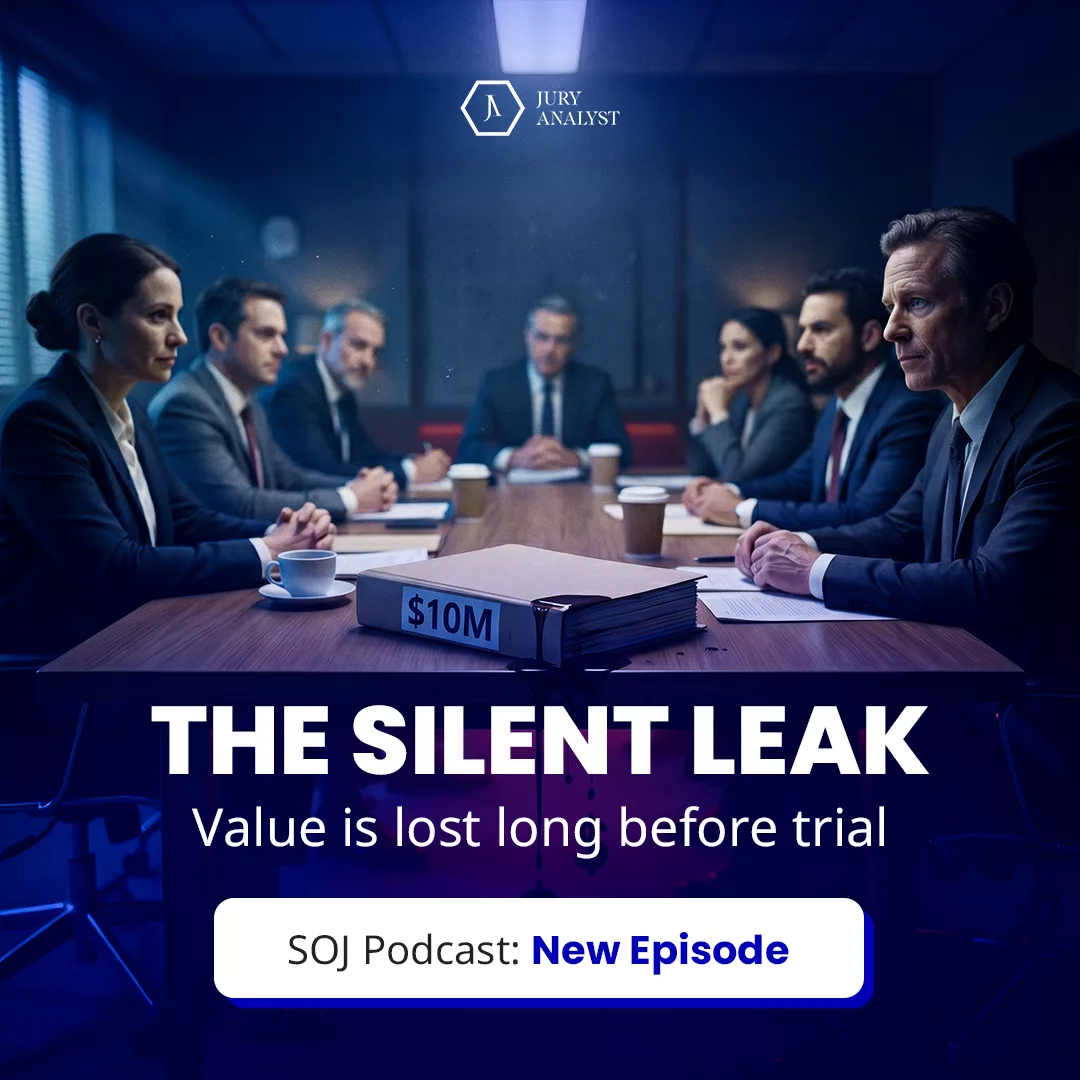
Do you know the moment your case starts to lose value?
Most plaintiff cases do not lose value at trial. It happens much earlier, during evaluation, when key risks go untested, and assumptions go unchallenged.
You can have clear liability, strong damages, and full internal agreement, and still lose millions before a jury is ever seated.
The Problem with Calling a Case “Strong”
At some point, most trial teams reduce a case to a simple conclusion.
“This is a strong case.”
It feels decisive. It creates alignment. It moves the case forward.
It also hides risk.
A case is not strong or weak in the abstract. It is made up of multiple factors that interact under pressure. When those factors are compressed into a single label, the details that actually determine outcome are no longer examined.
That is where value begins to slip.
The Interpretation Gap
Trial lawyers are trained to analyze facts, apply legal standards, and build structured arguments.
Jurors do something very different.
They interpret behavior.
They rely on their own experiences.
They look for a story that makes sense to them.
This creates a gap between legal evaluation and juror decision-making.
What feels like clear liability to a lawyer may feel explainable to a juror. What looks like a minor inconsistency in a file may feel like a credibility issue in deliberation.
That gap directly impacts how value is assigned.
Where Cases Actually Break
Cases rarely collapse because of one major failure. More often, they weaken through a series of smaller issues that compound over time.
A delay in treatment that is never fully explained. A detail in testimony that introduces doubt. A narrative that leaves unanswered questions. A venue that quietly limits outcomes.
Each issue on its own may seem manageable. Together, they shift how the case is interpreted.
Once that shift happens, leverage is lost.
The Risk of Internal Agreement
Alignment inside a trial team feels like strength.
In reality, it can create blind spots.
When everyone sees the case the same way, there is less pressure to challenge assumptions. Less incentive to test how the case performs outside the firm.
Internal clarity does not guarantee juror clarity.
It often creates a false sense of certainty.
Why Timing Matters
The cost of missing these issues increases over time.
If a weakness is discovered during trial preparation or mediation, the ability to correct it is limited. Depositions are complete. Strategy is already in motion. Expectations are set.
At that point, the focus shifts from maximizing value to protecting what remains.
Early evaluation is where leverage is either built or lost.
A Better Way to Evaluate Case Value
The shift is not about doing more work. It is about asking better questions earlier.
Instead of asking, “Is this a good case?” Ask, “How will this case be interpreted?”
That means looking at how liability will be perceived, not just proven. How causation will be understood, not just supported. How credibility will be judged, not just assumed.
It also means identifying where the narrative is incomplete and where jurors are likely to fill in the gaps.
This is not about more data. It is about better interpretation.
What This Means for Trial Strategy
When risks are identified early, strategy changes.
Discovery becomes more focused. Witness preparation becomes more precise. Narrative development becomes more intentional.
Most importantly, expectations align with how the case will actually perform.
That clarity preserves leverage.
The Question Every Trial Team Should Ask
Think about the strongest case on your docket right now.
Why is it strong?
Is that answer based on how your team sees the case? Or how a jury will interpret it?
That difference determines whether value is preserved or lost.
Final Thought
This is not about more evidence.
It is about how your case performs when it matters.
Miss that, and you are leaving value on the table long before trial begins.
Stay Ahead
Follow our Science of Justice podcast and subscribe to Science of Justice LinkedIn Newsletter for strategy-driven insights at the intersection of litigation psychology, behavioral data, and predictive intelligence. We partner with plaintiff trial teams to shape outcomes well before ever stepping into the courtroom.
Our science, your art. You bring the vision. We bring the data.